
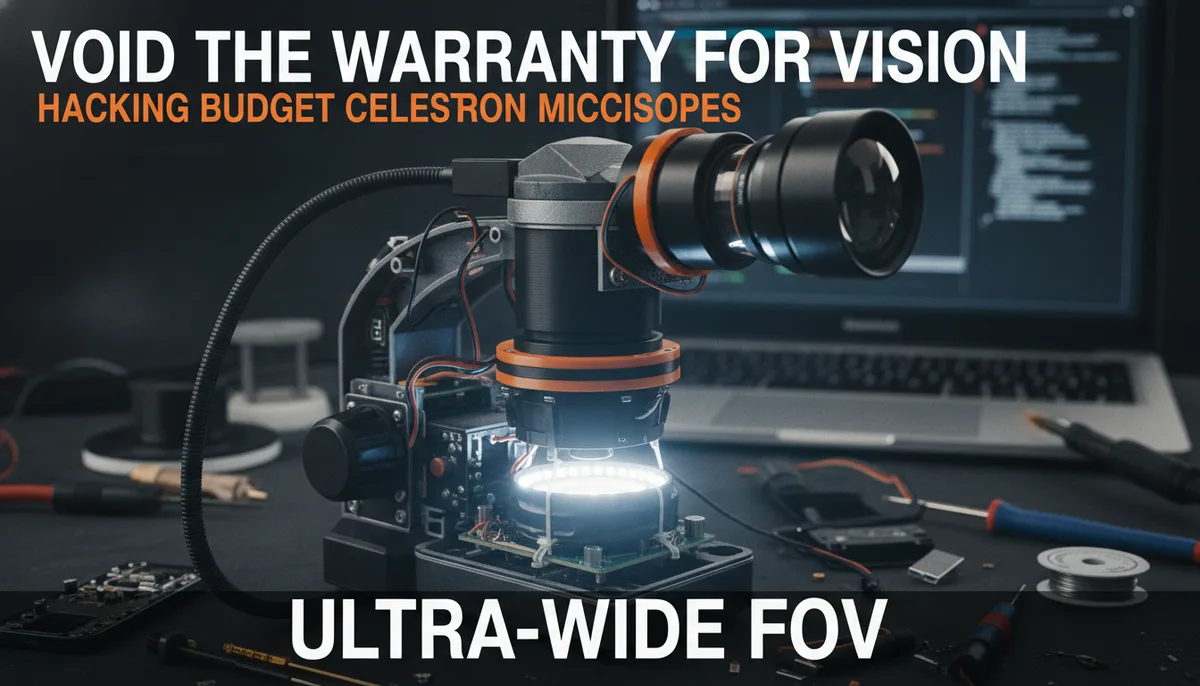
Voiding the Warranty for Vision: Hacking Budget Celestron Microscopes for Ultra-Wide FOV
The Philosophy of "Owning" Your Hardware
In the world of electronics and precision engineering, there is a distinct line between a consumer and a maker. A consumer uses a tool exactly as the manufacturer intended, adhering strictly to the boundaries of the user manual. A maker, however, views a piece of hardware as a starting point—a chassis for potential.
This philosophy is perfectly captured by the recent work of Matt BenDaniel, who documented a series of "hacks" performed on a budget Celestron microscope. His goal was simple yet ambitious: achieve an ultra-wide field of view (FOV) that the original hardware was never designed to provide. As BenDaniel aptly put it, "I’ve probably shot my Celestron warranty dead. But as hackers know, sometimes you gotta rush into warranty violations where angels fear to tread."
When you modify a tool to this extent, you "own" it in every sense of the word. You are no longer reliant on the manufacturer's support because you have surpassed their specifications. This mindset is essential for anyone looking to build a high-performance lab on a budget. Whether you are performing Emergency RC Repair: Soldering in the Pits or setting up a permanent bench, understanding how to push your gear further is a vital skill.
The Problem with Budget Optics
If you have ever purchased a digital microscope in the $50 to $150 range, you have likely encountered the "Magnification Trap." Manufacturers love to brag about "1000x magnification," but for the electronics hobbyist, high magnification is often the enemy of productivity.
The Magnification vs. Field of View Trade-off
In optics, magnification and field of view are inversely related. When you zoom in to see the microscopic structure of a crystal, you lose the context of the surrounding area. For soldering a surface-mount device (SMD), you don't need to see the atoms of the solder; you need to see the pad, the component lead, and the tip of your soldering iron simultaneously.
Budget microscopes like those from Celestron are often optimized for biological samples—looking at slides where a narrow, high-zoom view is acceptable. When applied to a PCB, these scopes often feel claustrophobic. You find yourself constantly moving the board or the microscope stand just to follow a single trace.
The Focal Distance Barrier
Another issue with budget scopes is the working distance. To get a clear image at high magnification, the lens often needs to be mere millimeters away from the target. This leaves no room for a soldering iron, let alone a hot air rework wand. Hacking the optics to provide a wider FOV often has the secondary benefit of increasing the working distance, giving you the "elbow room" needed for actual repair work.
Analyzing the Ultra-Wide FOV Hack
Matt BenDaniel’s approach to the Celestron microscope involves rethinking the relationship between the sensor and the objective lens. While specific budget models vary, the core of the hack usually involves one of three strategies:
- Removing Internal Barlow Lenses: Many budget scopes use internal corrective lenses to increase magnification. Removing these can instantly widen the FOV, though it may require moving the sensor or the objective lens to compensate for the change in focal point.
- Sensor Re-positioning: By changing the distance between the CMOS sensor and the primary lens, you can alter the magnification level. Moving the sensor closer to the lens generally decreases magnification and increases the FOV.
- Lens Swapping: Using C-mount or CS-mount adapters to fit wide-angle industrial lenses onto the Celestron chassis.
To get started with your own hardware modifications, it is helpful to have a solid foundation in what makes a tool "good" versus "hackable." For a deeper look at selecting the right gear for your bench, check out The Soldered Anywhere Master Buying Guide.
Celestron digital microscope
Why Warranty Violations are Sometimes Necessary
The phrase "Warranty Void if Removed" is often seen as a deterrent, but in the hacker community, it’s a challenge. When BenDaniel mentions rushing into warranty violations, he is highlighting a fundamental truth of specialized work: Off-the-shelf tools are designed for the average user, not the power user.
If you are working on high-density interconnect (HDI) boards or tiny 0201 components, a stock budget microscope will frustrate you. By voiding the warranty, you are essentially "paying" the cost of the device for the right to turn it into a tool that actually works for your specific needs. This is a common theme in the maker space, similar to how one might go Beyond the Data Sheet: Hacking the CR4501 Colorimeter for RAL Support. In both cases, the hardware is capable of more than the factory firmware or physical assembly allows.
Practical Steps for Hacking Your Microscope
If you are ready to "own" your Celestron microscope, follow these general steps to explore a wider field of view.
Step 1: Disassembly and Mapping
Carefully disassemble the outer casing. Budget microscopes are usually held together by small Phillips screws hidden under rubber pads or stickers. Once inside, identify the sensor board and the lens assembly.
New Upgrade Precision Screwdrive...
Step 2: Testing the Naked Sensor
Many digital microscopes use a standard thread for their lens assembly. If you unscrew the lens entirely, you can hold various external lenses (like those from an old security camera or a cheap set of phone macro lenses) in front of the sensor to see how the FOV changes. This "free-handing" stage helps you determine what focal length you need before you commit to a permanent mount.
Step 3: Modifying the Housing
To achieve an ultra-wide view, you may need to move the lens closer to the sensor than the original plastic housing allows. This often involves cutting away sections of the internal plastic or 3D printing a new, shorter lens barrel.
Step 4: Sensor Stabilization
When you move the sensor or change the optics, you might introduce "sensor tilt," where one side of the image is in focus while the other is blurry. Use small shims or adjustable screws to ensure the sensor is perfectly perpendicular to the light path.
optical lens cleaning kit
The Result: A Professional Soldering Station
Once the hack is complete, the difference is night and day. An ultra-wide FOV Celestron allows you to:
- Maintain Situational Awareness: See the entire quadrant of a motherboard while soldering a single pin.
- Improve Hand-Eye Coordination: Because you can see your tools entering the frame from the periphery, your movements become more natural.
- Reduce Eye Strain: A wider, clearer view at lower magnification is much easier on the brain than trying to interpret a blurry, high-zoom image.
This modification transforms a $100 toy into a piece of laboratory equipment that rivals entry-level professional stereo microscopes costing five times as much. You lose the ability to return it to the store, but you gain a tool that is perfectly tuned to your workflow.
Conclusion: The Value of Custom Tools
Matt BenDaniel’s hack is a reminder that we are not limited by the tools we can afford, but by our willingness to modify them. The budget Celestron microscope is a capable platform, but its factory settings are often a bottleneck for serious electronics work.
By embracing the "warranty dead" mindset, you open up a world of possibilities. You move from being a user of tools to a creator of systems. Whether you are hacking a microscope for better vision or streaming data from a multimeter, the goal is the same: total control over your environment.
In the end, the best tool in your shop isn't the most expensive one—it's the one you’ve modified until it fits your hand and your eyes perfectly. Don't be afraid to rush in where angels fear to tread; the view from the other side is worth it.
Related product: Celestron LCD Digital Microscope...
Related product: 100 Cleanroom Foam Tip Cleaning...
Related product: Celestron LCD Digital Microscope...
Related product: 100 Cleanroom Foam Tip Cleaning...