
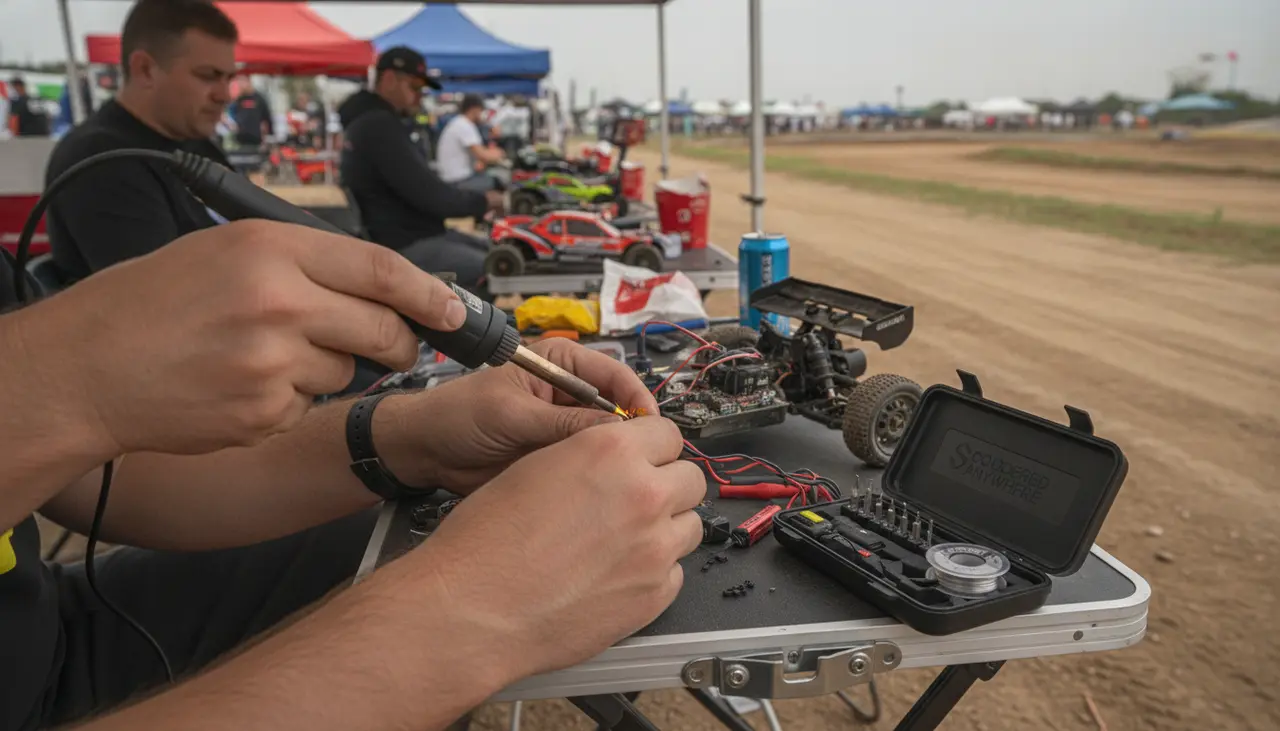
Emergency RC Repair: Soldering in the Pits
We’ve all been there. You’re mid-heat, your lap times are dropping, and suddenly—nothing. You pull your car off the track only to find a battery lead has vibrated loose or a motor wire has snapped. The adrenaline is still pumping, the next race starts in ten minutes, and your soldering station is miles away at home.
Performing an RC car soldering repair in the pits is a high-pressure scenario that requires a different approach than working at a comfortable workbench. To succeed, you need a combination of the right portable hardware, a reliable power source, and a few "from-the-field" tricks to deal with wind, dirt, and shaky hands.
The Quick Answer: How to Succeed at Trackside Soldering
To successfully repair an RC car in the pits, you need a high-wattage portable soldering iron (at least 65W via USB-C PD or a LiPo battery) and a clean workspace. Focus on high-heat, short-duration joints to prevent melting nearby plastic components, and always use a dedicated flux pen to fight through trackside grime.
Who This Guide Is For
This guide is specifically for RC enthusiasts—whether you’re racing 1/10 scale buggies, bashing 1/8 scale monster trucks, or flying FPV drones—who need a reliable way to fix electronics away from an AC outlet. If you’ve ever felt the frustration of a "DNF" (Did Not Finish) because of a simple wire failure, this is for you.
Choosing Your Pit Lane Weapon
When you're in the pits, you don't have time to wait five minutes for a butane iron to warm up, and you don't want to struggle with a weak, battery-powered wand that can't handle 12-gauge wire.
| Feature | USB-C PD Irons (e.g., Pinecil V2) | Butane Irons | Battery-Integrated (e.g., Weller BL60MP) |
|---|---|---|---|
| Heat-up Time | 6–10 Seconds | 30+ Seconds | 15–30 Seconds |
| Temperature Control | Precise Digital (PID) | Manual Valve (Variable) | Basic High/Low |
| Max Power | Up to 65W–88W | High (but inconsistent) | Limited (usually <15W) |
| Wind Resistance | Excellent | Poor (flame can blow out) | Excellent |
| Best For | Precision & High-Power | Emergency Heat Shrink | Light Duty / Thin Wires |
For a deeper look at the hardware that makes these repairs possible, check out The Soldered Anywhere Master Buying Guide.
Essential Gear for the "Emergency Kit"
A portable iron is only half the battle. To handle a true trackside emergency, your pit bag should include:
- The Iron: A Pinecil V2 or Miniware TS101. These use IronOS for incredible temperature stability.
- The Power: A 65W+ USB-C PD Power Bank or an XT60-to-DC cable to run the iron directly off your car's 4S or 6S LiPo batteries.
- The Flux: A "no-clean" flux pen. This is non-negotiable for field repairs where wires are often oxidized or dirty.
- The Solder: 60/40 Lead-tin or a high-quality lead-free wire with a rosin core.
- The Tip: A "Chisel" or "BC2" tip. Small conical tips often fail to transfer enough heat to thick RC battery wires.
Step-by-Step: The High-Pressure Repair
When the race clock is ticking, follow this workflow to ensure your fix holds through the final jump.
1. Clean the "Track Grime"
RC cars live in the dirt. Before you even touch the iron to the wire, use a small brush or a dab of isopropyl alcohol to clean the area. Soldering onto dirt or tire prep residue will result in a "cold joint" that will fail on the first jump.
2. Power Up and Crank the Heat
If you are soldering thick motor wires (12AWG or 14AWG), don't be afraid to set your iron to 380°C (715°F). In the field, the ambient air and wind will sap heat from your tip.
3. Use the "Mechanical Hook"
In a workshop, we rely on the solder for the bond. In the pits, try to get a small mechanical twist or hook between the wires if possible. This helps hold the connection steady while your hands are shaking from the race-day jitters.
4. The Quick Melt
Apply flux to both the wire and the pad. Tin your iron tip, then touch it to the joint. Feed the solder directly into the point where the tip meets the wire. As soon as it flows, remove the heat.
Tip: If you're using a Pinecil, you might want to read our Pinecil V2 Review: Is the Hype Actually Real? to see how it handles these high-drain scenarios.
Best For Use-Case Recommendations
- Best for 1/8 Scale Racing: The Pinecil V2 with an XT60 cable. The ability to pull 80W+ from a 6S LiPo means you can solder heavy-duty ESC connections in seconds.
- Best for FPV Drone Gates: The TS101. Its ergonomic shape makes it easy to reach into tight carbon fiber frames to re-attach a motor signal wire.
- Best for Trail Hikers/Crawlers: A 65W Power Bank paired with any USB-C iron. It ensures you have enough capacity for multiple repairs during a long day in the woods.
Common Beginner Mistakes in the Field
- Underpowering the Iron: Trying to use a standard phone charger (5W-10W) to power a USB-C iron. It will either not turn on or fail to melt the solder on a large connector. Always use a 65W PD source.
- Forgetting to Tin the Tip: When you're done, always leave a glob of solder on the tip before turning it off. This protects the tip from the humid or dusty outdoor air. For more on this, see our 5 Essential Solder Tips for Portable Irons: The Ultimate Field Guide.
- Ignoring the Wind: A stiff breeze can act like a giant heat sink. If you're struggling to get heat into a joint, use your pit towel or a teammate's hand to block the wind.
FAQ: RC Field Soldering
Q: Can I solder safely near LiPo batteries? A: Yes, but be extremely careful. Never let your iron tip touch the battery casing, and ensure you don't short the positive and negative leads together with your solder or tools.
Q: Why won't my solder stick to the motor tab? A: It’s likely a combination of old solder and dirt. Use a flux pen and ensure your iron is set to a high enough temperature. Portable irons need a second or two longer to "recover" heat when touching large metal tabs.
Q: Is butane better for outdoor use? A: Generally, no. While butane is cordless, the open exhaust can melt nearby plastic parts on an RC car, and the flame is very sensitive to wind. Modern USB-C irons offer much better precision and safety.
Affiliate Disclosure: This post contains affiliate links for portable soldering kits and accessories. If you click through and make a purchase, we may earn a small commission at no additional cost to you, which helps us keep the lights on at Soldered Anywhere.