
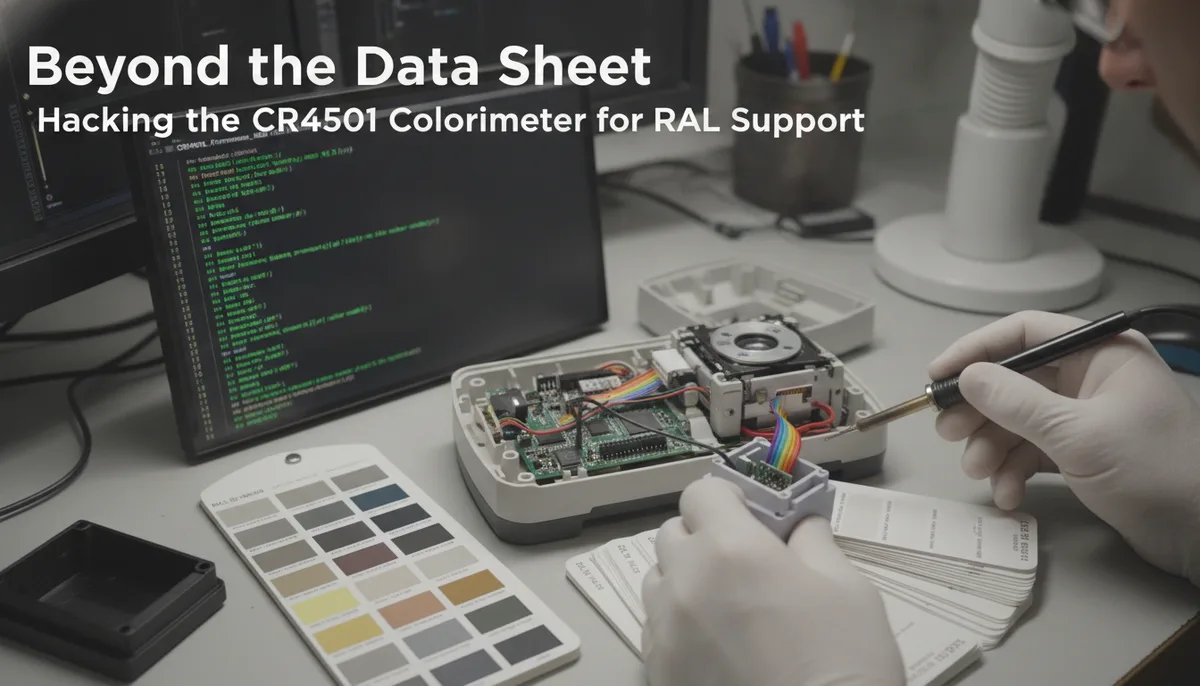
Beyond the Data Sheet: Hacking the CR4501 Colorimeter for RAL Support
In the world of professional finishing, powder coating, and industrial design, color accuracy isn’t just a preference—it’s a requirement. For most makers and engineers, the tool of choice for verifying these colors is either a physical deck of reference swatches or a digital colorimeter. However, even the most expensive commercial tools often suffer from "walled garden" software that prioritizes proprietary databases over the user’s actual workflow.
This was exactly the challenge faced by [hallko1234], who found that using a standard CR4501 colorimeter involved a frustrating amount of "sneakernet." Every measurement required a trip back to the office to cross-reference raw data with a RAL color table. The solution? A deep dive into firmware reverse engineering to make the hardware work exactly the way it should have from the factory.
The Problem with Commercial Colorimetry Workflows
A colorimeter, at its core, is a device that perceives color much like the human eye does, using filtered sensors to measure the tristimulus values of light. While the CR4501 is a capable piece of hardware for its price point, its stock firmware is often limited to basic color space outputs like Lab or HEX.
For those working in industrial settings, the RAL color standard is the gold standard. If you are trying to match a machine part to a specific powder coat, a HEX code is virtually useless. You need the RAL number. The standard workflow for the CR4501 involved taking a reading, recording it, and then manually searching a lookup table on a separate computer. This disconnect between data acquisition and data utility is a common theme in "budget" professional hardware.
Reverse Engineering the CR4501: The Ghidra Approach
To bridge this gap, [hallko1234] turned to reverse engineering. The first step in any firmware hack is getting the code off the device. Fortunately, the CR4501 proved to be relatively "talkative" over its debug port. By tapping into the onboard microcontroller, the entire firmware blob was extracted for analysis.
This is where the heavy lifting begins. Using Ghidra, the open-source reverse engineering suite developed by the NSA, the binary data was decompiled into a human-readable (or at least "human-interpretable") format.
Navigating the Binary Labyrinth
Reverse engineering commercial firmware isn't as simple as reading source code. You are looking at assembly language and decompiled C that lacks variable names, comments, or clear structures. The process involves:
- Identifying String References: Searching for text that appears on the device screen (like "Measure" or "Success") to find the functions responsible for display output.
- Tracing Data Flow: Following the signal from the color sensor through the math routines that convert raw sensor data into color space coordinates.
- Locating the Hook: Finding a specific point in the execution loop where custom code can be injected without crashing the system.
ST-Link V2 Debugger for STM32
The High Stakes of Firmware Patching
Modifying firmware is a high-wire act. Unlike software running on a modern OS, embedded systems often have no safety net. During the development process, [hallko1234] encountered the nightmare scenario for any hardware hacker: a bricked device.
Even worse than a simple bricking was the accidental erasure of the device's factory calibration data. Colorimeters rely on highly specific calibration constants stored in non-volatile memory (EEPROM or Flash) to account for the unique variances in their sensors and LEDs. Once that data is gone, the device is essentially a paperweight until it can be re-calibrated against a known white standard.
If you find yourself in a similar situation with a dead device, you might find our guide on Resurrecting Bricked Hardware: How an RP2040 Bypassed a Cricut Serial Lockdown useful for understanding the persistence required to bring hardware back from the brink.
Implementing the RAL Lookup Table
Once the firmware was understood and a stable patching method was established, the goal was to integrate a RAL lookup table directly into the device.
The RAL system consists of a defined set of colors, each with specific Lab (Lightness, a, b) coordinates. The hack involved:
- Creating a Compact Database: Storing the RAL table within the limited flash memory of the CR4501.
- Calculating "Delta E": When a measurement is taken, the patched firmware calculates the Euclidean distance (Delta E) between the measured color and every color in the RAL database.
- Displaying the Result: The screen was modified to display the closest RAL match and the "closeness" score, allowing the user to know instantly how accurate the match is.
The result is a device that provides immediate, actionable information in the field. No more running back to the office; the tool now speaks the language of the workshop.
Tools for the Modern Hardware Hacker
Projects like this highlight the shift in the maker movement. We are no longer just building things from scratch; we are "fixing" the commercial products we buy. To perform this level of modification, your bench needs more than just a screwdriver.
Essential Kit for Firmware Hacking
- Logic Analyzers: Crucial for sniffing communication between the MCU and the display or sensors. Logic Pro 8
- Precision Soldering: Accessing debug ports often requires soldering tiny bodge wires to SMD pads. For this, a high-quality, portable iron is indispensable. We’ve previously discussed how the right iron can make or break a project in our Pinecil V2 Review: Is the Hype Actually Real?
- Programmers/Debuggers: Tools like the ST-Link or J-Link are necessary to interface with the chip's SWD or JTAG ports.
Why This Hack Matters
The CR4501 RAL patch is more than just a convenience; it’s a statement on "Right to Repair" and "Right to Modify." When we purchase hardware, we often accept the limitations imposed by the manufacturer’s software team. [hallko1234] has shown that with enough patience and the right tools, those limitations are merely suggestions.
By creating an online tool to help others install this patch, the project has moved from a personal fix to a community resource. It transforms a $100 colorimeter into a tool that rivals much more expensive industrial units in terms of specific utility.
Conclusion: Taking Control of Your Tools
If you own a CR4501—or any piece of gear that almost, but doesn't quite, meet your needs—let this be an inspiration. The barrier to entry for firmware hacking has never been lower, thanks to tools like Ghidra and the wealth of knowledge shared in the maker community.
Whether you are matching paint for a restoration project or ensuring brand consistency in a manufacturing run, having a tool that works with you rather than against you is worth the risk of a few "bricked" attempts. Just remember to back up your calibration data first.
For those looking to upgrade their entire mobile workbench to handle high-stakes hacks like this, check out The Soldered Anywhere Master Buying Guide for our top recommendations on portable gear that doesn't compromise on power.
Related product: Waveshare ST-LINK/V2 Mini In-cir...
Related product: Logic Pro 8
Related product: Waveshare ST-LINK/V2 Mini In-cir...