
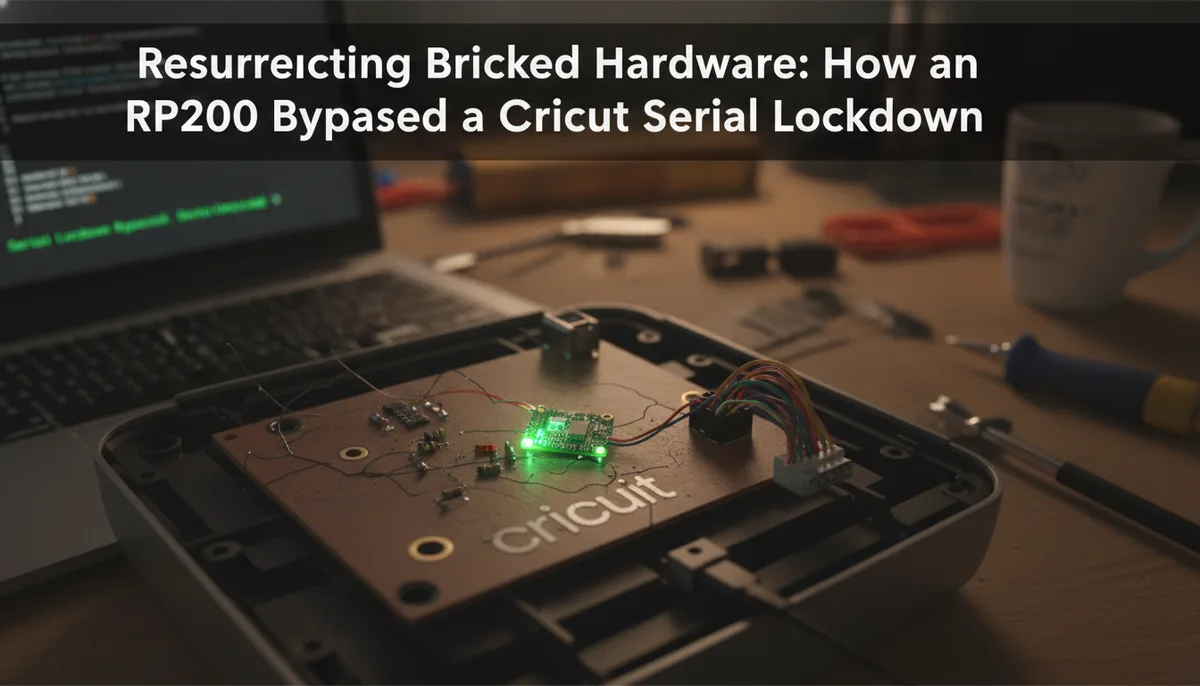
Resurrecting Bricked Hardware: How an RP2040 Bypassed a Cricut Serial Lockdown
In the world of modern consumer electronics, "ownership" is often a tenuous concept. We buy devices, but the software that runs them frequently remains under the tight control of the manufacturer. This reality becomes painfully clear when a perfectly functional piece of hardware is "deactivated" remotely, turning a $400 machine into a decorative paperweight.
Recently, security researcher [xssfox] demonstrated a brilliant workaround for this exact scenario. After finding a Cricut Maker in an e-waste disposal bin, she discovered that the machine had been software-locked—likely as part of a warranty replacement cycle. Through a combination of mechanical repair and clever USB packet interception using an RP2040, she managed to bring the machine back to life.
This project serves as a masterclass in hardware salvage and highlights the vulnerabilities in simplistic device-cloud authentication.
Assessing the E-Waste: Mechanical vs. Digital Failure
When rescuing hardware from the scrap heap, the first step is always a physical triage. In the case of this Cricut Maker, the physical condition was surprisingly good. The only major mechanical failure was "perished rollers"—a common issue where the rubber or plastic components degrade over time, becoming sticky or brittle.
Mechanical repairs like this are the bread and butter of the maker community. Replacing rollers requires patience and a bit of teardown, but it doesn't require a degree in computer science. However, the real challenge appeared once the machine was powered on. Upon connecting it to the official Cricut software, the device reported itself as "deactivated."
In the Cricut ecosystem, deactivation is a permanent software lock. When a user reports a fault and receives a warranty replacement, Cricut blacklists the original serial number in their database. The next time that machine "phones home" via the Design Space software, it is rendered useless. For most users, this is the end of the road.
The Hunt for a Vulnerability: Analyzing the Motherboard
To bypass a software lock, you must first understand how the machine identifies itself. [xssfox] began by examining the Cricut Maker’s internal circuitry.
In many older or less secure devices, the serial number might be stored on an external EEPROM (Electrically Erasable Programmable Read-Only Memory) chip. If that were the case, a hacker could simply desolder the chip, read the data, modify the serial number to one that isn't blacklisted, and flash it back.
However, the Cricut Maker's motherboard didn't offer such an easy target. The microcontroller used was not one for which [xssfox] had a compatible debugger, making a direct firmware dump or "on-chip" modification difficult. When the hardware path is blocked, the next logical step is to look at the communication path.
Intercepting the Handshake: USB Protocol Sniffing
Since the Cricut Maker must communicate with a PC to receive cutting instructions, it uses a standard USB connection. This is where the security flaw was discovered.
By using software tools to intercept the communication between the Cricut and the host computer, [xssfox] observed the "handshake" process. Surprisingly, the machine was sending its serial number to the host PC in plain text. There was no encryption, no cryptographic signing, and not even a basic checksum to verify the integrity of the identification string.
This is a classic "security through obscurity" failure. The designers likely assumed that because the average user wouldn't know how to look at USB packets, they didn't need to protect the serial number data. This oversight opened the door for a "Man-in-the-Middle" (MitM) attack.
The RP2040 Solution: A Hardware Man-in-the-Middle
To fix the "deactivated" status, the software needed to see a serial number that wasn't on the blacklist. Since the machine itself couldn't easily be changed, [xssfox] decided to change the data while it was in transit.
She employed an RP2040 microcontroller—the same chip found in the Raspberry Pi Pico—to sit between the Cricut Maker and the PC. The setup worked as follows:
- Physical Bridge: The Cricut was plugged into the RP2040, and the RP2040 was plugged into the PC.
- Packet Relaying: The RP2040 was programmed to pass almost all USB traffic back and forth transparently, so the PC still "saw" a Cricut machine.
- Serial Spoofing: The code was written to watch for the specific packet containing the serial number. When that packet appeared, the RP2040 intercepted it, swapped the blacklisted serial number for a different (valid) one, and sent the modified packet to the PC.
The result? The Cricut software believed it was talking to a perfectly legitimate, active machine. The hardware lock was effectively bypassed without ever touching the Cricut's original firmware.
For projects involving this level of precision soldering—especially when bridging tiny traces on a microcontroller—having the right tools is essential. If you're looking to upgrade your bench for similar salvage operations, check out our Pinecil V2 Review: Is the Hype Actually Real? to see if this portable iron fits your workflow.
Raspberry Pi Pico RP2040 microcontroller
Why This Matters for the Right to Repair
The success of this hack is a victory for the Right to Repair movement, but it also highlights a frustrating trend in product design. The Cricut Maker in question was mechanically sound (once the rollers were fixed). It was only "broken" because a line of code in a remote database said it should be.
This practice of "remote bricking" contributes significantly to the global e-waste problem. When manufacturers make it impossible to transfer ownership or repair older devices through software locks, functional hardware ends up in landfills.
Hacks like this demonstrate that with enough technical knowledge, we can reclaim our hardware. However, it shouldn't require a Man-in-the-Middle microcontroller attack just to use a machine you've salvaged or purchased second-hand.
Practical Tips for Your Own Hardware Rescues
If you find yourself staring at a piece of "bricked" e-waste, here are a few takeaways from [xssfox]’s success that can guide your own project:
1. Don't Overlook the Mechanical
Before diving into code, ensure the device is worth saving. Perished rollers, dried-out capacitors, or blown fuses are often the "real" reason a device was tossed. If you're working in the field or at a maker space, make sure you're using the right techniques for these repairs. See our guide on 5 Essential Solder Tips for Portable Irons: The Ultimate Field Guide for advice on maintaining your equipment during complex teardowns.
Cricut Maker replacement rubber rollers
2. Follow the Data
If the firmware is locked down, look at the ports. Whether it's USB, Serial (UART), or even I2C, the way a device talks to the outside world is often its weakest point. A simple logic analyzer can reveal if data is being sent in the clear.
USB Logic Analyzer 24MHZ 8 Chann...
3. Microcontrollers are Your Best Friend
The RP2040 is particularly powerful for this because of its PIO (Programmable I/O) blocks, which can be configured to handle various communication protocols at high speeds. It’s an affordable way to create custom "translators" for hardware that refuses to behave.
Conclusion
The story of the spoofed Cricut serial number is a reminder that "deactivated" doesn't always mean "dead." By understanding the communication between hardware and software, we can find creative ways to bypass artificial limitations.
While [xssfox] suspects a software-only solution (like a custom driver or a local proxy) might be possible in the future, her hardware-based RP2040 bridge is a definitive proof of concept. It stands as a testament to the power of the maker community to fight back against planned obsolescence and keep high-quality machinery out of the bin.
If you're just starting your journey into hardware hacking and repair, ensure you have the right foundational gear. Our The Soldered Anywhere Master Buying Guide covers everything from basic irons to advanced diagnostic tools to help you tackle your next e-waste rescue.
Related product: 4 Pcs Cricut Joy & Cricut Maker...
Related product: Raspberry Pi Pico Microcontrolle...
Related product: USB Logic Analyzer 24MHZ 8 Chann...
Related product: 4 Pcs Cricut Joy & Cricut Maker...
Related product: Raspberry Pi Pico Microcontrolle...