
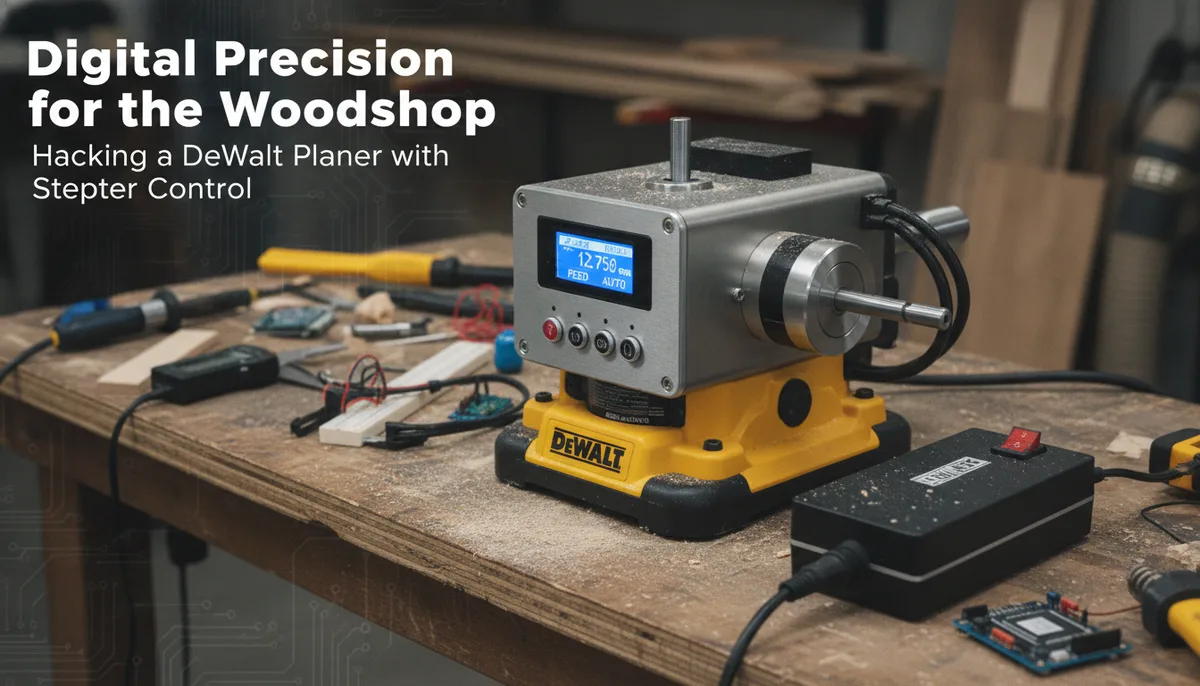
Digital Precision for the Woodshop: Hacking a DeWalt Planer with Stepper Control
In the world of woodworking, the thickness planer is often the unsung hero of the shop. It is the machine that takes rough-sawn, cupped, or twisted lumber and transforms it into uniform, parallel stock ready for joinery. However, as any craftsman who has spent an afternoon prepping 100 board feet of oak can tell you, the manual adjustment wheel on a standard planer is a bottleneck.
Standard consumer-grade planers, such as the ubiquitous DeWalt models found in many home shops, require dozens of full rotations to move the cutter head through its vertical range. While this mechanical advantage is necessary for manual operation, it becomes a tedious chore during routine maintenance or when switching between wildly different stock thicknesses.
Enter [DendroLabsDev], a maker who saw an opportunity to bridge the gap between traditional woodworking and digital fabrication. What began as a "quick hack" to make greasing the planer's internal posts easier has evolved into a fully programmable, high-precision control system that rivals the features found on industrial machines costing five times as much.
The Mechanical Bottleneck: Why Manual Isn't Enough
The primary challenge with manual planers lies in the relationship between the adjustment wheel and the lead screws. To provide the user with enough leverage to lift the heavy motor and cutter head assembly, the gear ratio is intentionally high. This means that a single turn of the wheel only moves the head a fraction of an inch.
While this is great for fine-tuning, it is a nightmare for efficiency. If you are moving from planing 2-inch thick bench legs down to 1/2-inch drawer sides, you are looking at significant physical effort. Furthermore, manual adjustment relies on a physical scale that is often difficult to read with sub-millimeter accuracy.
By replacing the handwheel with a high-torque stepper motor, [DendroLabsDev] eliminated the physical labor and replaced it with digital precision. This isn't just about saving your arm muscles; it’s about the consistency of the finished product. If you need to replicate a specific board thickness six months after the initial project, a manual scale won't get you there—but a saved digital preset will.
The Technical Core: Stepper Motors and Resolution
At the heart of this upgrade is a stepper motor. Unlike a standard DC motor, which spins freely when power is applied, a stepper motor moves in discrete "steps." In this specific build, the system is capable of roughly 1000 steps per inch of vertical travel.
This level of resolution—0.001 inches per step—effectively turns the planer into a single-axis CNC machine. When you can command a machine to move exactly one-thousandth of an inch, your tolerances for joinery become incredibly tight. This is particularly useful for tasks like creating "glueless" friction fits or preparing thin veneers where even a slight over-adjustment can ruin the workpiece.
To drive a motor of this size, you need more than just a battery. A dedicated motor driver and a robust power supply are required to handle the torque needed to lift the cutter head assembly. If you are looking to source components for a similar build, our The Soldered Anywhere Master Buying Guide covers the essential electronics and soldering gear you'll need to get started.
NEMA 23 High Torque Stepper Motor 3Nm
Programmable Logic: Beyond Simple Up and Down
The real magic of [DendroLabsDev]’s project isn't just that the motor moves the head; it’s the intelligence behind the movement. By using a microcontroller (like an Arduino or ESP32), several advanced modes were implemented that change the fundamental workflow of the machine:
1. The Multi-Pass Workflow
Planing a board from 1 inch down to 1/2 inch in a single pass is a recipe for a broken machine or a ruined board. Standard practice is to take multiple light passes. The motorized system can be programmed to handle this automatically. You input the starting thickness and the target thickness, and the controller steps the head down by a predetermined amount (e.g., 1/32") after each pass.
2. Digital Zeroing
Because wood varies and blades wear down, the system includes a zeroing device. This allows the user to calibrate the "floor" of the machine. Once zeroed, the digital readout reflects the actual thickness of the board with absolute certainty, removing the guesswork of the manual pointer.
3. Preset Memory
Woodworkers often work with "standard" thicknesses: 3/4" for cabinet carcasses, 1/2" for drawer bottoms, or 1/4" for decorative slats. The ability to save these as presets means you can jump between tasks without measuring every single time.
This level of customization is a classic example of "hacking" hardware to meet professional needs. We've seen similar logic applied in other fields, such as when we explored Beyond the Data Sheet: Hacking the CR4501 Colorimeter for RAL Support, where software overrides turned a basic tool into a professional-grade instrument.
Building the Control System
For those looking to replicate this setup, the hardware side involves more than just bolting a motor to the side of the planer. You need a way to interface the motor with the existing lead screw. This usually involves a timing belt or a direct coupler, depending on the planer's architecture.
The control interface is equally important. [DendroLabsDev] is working on a custom PCB and enclosure to make the system more accessible. A clean UI—likely using a small OLED screen and a rotary encoder—allows the woodworker to interact with the machine without needing to plug in a laptop.
When working on these types of shop upgrades, you often find yourself soldering in less-than-ideal conditions, perhaps even right on the assembly table. If you need tips for maintaining your gear or making quick fixes in the workshop, check out our guide on Emergency RC Repair: Soldering in the Pits, which offers practical advice for mobile soldering setups.
TB6600 Stepper Motor Driver 4A 9-42V
The Future of the "Smart" Workshop
The trend of adding electronics to traditionally "dumb" woodworking tools is accelerating. We have seen CNC-controlled scroll saws, automated fence systems for table saws, and now, programmable planers.
The goal isn't to remove the "craft" from woodworking, but to remove the "tedium." By automating the repetitive and physically demanding aspects of tool setup, the craftsman can focus more on design, joinery, and finishing. The accuracy provided by [DendroLabsDev]'s system ensures that the parts coming off the machine are perfect, which in turn makes the manual assembly process much more rewarding.
[DendroLabsDev] has expressed plans to open-source or productize this control system. This would allow woodworkers who aren't necessarily electronics experts to benefit from the precision of a motorized planer without having to write their own code from scratch.
Final Thoughts: Should You Automate Your Planer?
If you are a hobbyist who planers one or two boards a month, this project might be overkill. However, if you are a production-minded woodworker or someone who values extreme precision, the benefits are clear.
The ability to dial in a thickness of exactly 0.750 inches and have it be repeatable across a dozen boards is a game-changer. It eliminates the "test piece" phase of woodworking and reduces material waste. As we continue to see makers push the boundaries of what consumer tools can do, the line between the home workshop and the industrial factory continues to blur.
For those ready to take the plunge into workshop automation, start by mastering the basics of motor control and digital readouts. The components are more affordable than ever, and the community support for projects like [DendroLabsDev]'s planer mod is vast. Whether you're upgrading a DeWalt or a generic benchtop model, the path to a smarter shop starts with a single step—or in this case, a thousand steps per inch.
Digital Calipers 6 Inch Stainless Steel
Related product: Kynup Digital Caliper
Related product: High Torque Nema 23 Stepper Moto...
Related product: TB6600 4A 9-42V Stepper Motor Dr...
Related product: DEWALT Thickness Planer
Related product: Kynup Digital Caliper
Related product: High Torque Nema 23 Stepper Moto...
Related product: TB6600 4A 9-42V Stepper Motor Dr...