
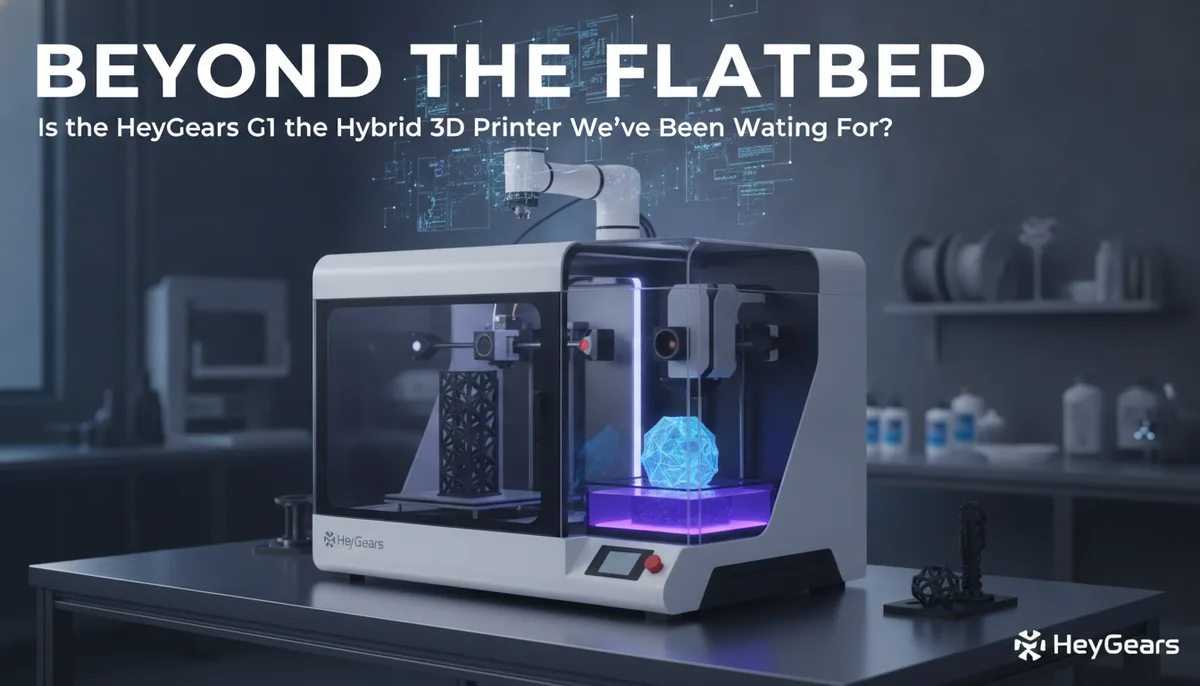
Beyond the Flatbed: Is the HeyGears G1 the Hybrid 3D Printer We’ve Been Waiting For?
The world of prosumer manufacturing is currently witnessing a collision of two previously distinct technologies: UV flatbed printing and 3D additive manufacturing. For years, makers have had to choose between the "print-on-anything" versatility of a UV flatbed—perfect for custom enclosures and phone cases—and the structural complexity of SLA or FDM 3D printing.
The HeyGears G1, currently generating significant buzz on Kickstarter, attempts to erase that line. By marketing a machine that functions as both a high-end UV flatbed and a full-color 3D printer, HeyGears is targeting a specific niche of designers, engineers, and hobbyists who demand "SLA quality without the mess." But does this hybrid approach actually deliver, or is it a jack-of-all-trades that masters none?
The Hybrid Architecture: How UV Inkjet Becomes 3D
To understand the HeyGears G1, one must first understand the tech under the hood. Unlike a traditional SLA printer that pulls a part out of a vat of resin, or an FDM printer that extrudes molten plastic, the G1 utilizes an Epson-brand print head.
In a standard UV flatbed setup, this head deposits thin layers of ink that are instantly cured by a UV light source. The G1 takes this a step further by utilizing specialized UV resins that can be built up layer-by-layer to create three-dimensional objects. This "2.5D" to 3D transition allows for textures, Braille, and fully realized 3D geometries, all while maintaining the full CMYK color gamut.
The precision here is notable. With layers as small as 10 microns (um), the G1 rivals high-end resin printers in terms of surface finish. For those coming from the world of soldering and electronics, this level of detail is critical when creating custom jigs or specialized enclosures for delicate PCB work. If you are looking to stock your bench with high-precision tools, you might also want to check out The Soldered Anywhere Master Buying Guide for a broader look at essential maker gear.
Build Volume and Physical Footprint
The HeyGears G1 isn't designed to print large-scale furniture, but for the prosumer desktop, its volume is respectable. You get two choices of bed, with the larger variant offering a build area of 420 mm x 320 mm x 130 mm.
While 130 mm of Z-height might seem modest compared to some dedicated 3D printers, it is gargantuan for a UV flatbed. This height allows for the printing of substantial enclosures, personalized trophies, or even small-batch production of consumer electronics housings. The machine can hold up to 6 KG of UV ink/resin, which is a significant capacity designed to minimize downtime during long print runs.
UV resin 3D printer wash and cure station
The "Mess-Free" Promise: A Better SLA Alternative?
One of the primary barriers to entry for resin (SLA) printing is the post-processing nightmare. Dealing with vats of toxic liquid, IPA baths, and the inevitable sticky residue makes many makers stick to FDM.
The G1 offers a compelling alternative. Because the resin is jetted precisely where it is needed rather than the part being submerged in a pool of it, the "mess factor" is significantly reduced. You get the crisp edges and microscopic detail of resin printing without the biohazard cleanup. For a professional workspace or a home office, this cleanliness is a major selling point.
However, precision in 3D space requires more than just a good printer; it requires a streamlined digital workflow. Navigating complex 3D models for a printer this precise can be a chore with a standard mouse. We’ve previously discussed how tools like the Rotatrix: Revolutionizing 3D Navigation for CAD and Design Workflows can drastically improve the design phase, making it easier to take full advantage of the G1's 10-micron resolution.
The Economics of Ink: Open vs. Closed Ecosystems
A common pitfall in the prosumer printing world is the "inkjet trap"—selling the hardware at a discount and recouping the costs through proprietary, over-priced cartridges.
HeyGears seems to be taking a more "maker-friendly" middle ground. While their official CMYK kit is expected to MSRP at $189 USD, they are selling the ink in bottles rather than locked cartridges. This is a crucial distinction. It means that while the manufacturer would prefer you use their optimized formulas, the system is physically capable of accepting third-party UV inks.
For the budget-conscious maker, this opens the door to experimentation. However, the use of an Epson-brand head means you’ll want to be careful; low-quality third-party inks can clog fine nozzles, leading to expensive repairs.
Epson print head cleaning kit for UV printers
Real-World Performance: Early Reviews
The skepticism surrounding Kickstarter hardware is always healthy. However, early review copies have already landed in the hands of reputable creators. Notably, Steve Makes Everything has showcased the G1 in action, and the results appear to validate the manufacturer's claims.
The ability to print a full-color image directly onto a 3D-printed object as it is being created is the "holy grail" for many. In the video demonstrations, the transition between the flatbed "print-on-anything" mode and the full 3D mode appears seamless. Whether you are printing a photo onto a piece of wood or growing a full-color miniature from the build plate, the G1 handles the dual-role with surprising stability.
Is the $2,000 Price Tag Justified?
The "Super Early Bird" price of approximately $2,000 USD is a significant investment. For the same price, a maker could buy a top-tier FDM printer, a mid-range SLA printer, and a dedicated wash-and-cure station.
So, who is the G1 for?
- The Small-Batch Entrepreneur: If you sell custom-branded gear, the ability to print 3D textures and full-color logos in one pass is a game-changer.
- The Electronics Enthusiast: Creating professional-grade, full-color enclosures for projects like the Wireless LCD Streaming for the ANENG AN870 becomes trivial with this hardware.
- The Space-Constrained Pro: If you don't have room for a messy resin station and a separate flatbed, this hybrid solves a major logistical hurdle.
3D Printer Filtration System wit...
Final Thoughts: The Future of Desktop Manufacturing
The HeyGears G1 represents a shift toward more integrated, cleaner, and more versatile desktop manufacturing. While the MSRP will undoubtedly be higher than the Kickstarter entry price, the machine fills a gap that has existed for years.
It isn't just a 3D printer, and it isn't just a UV flatbed. It is a specialized tool for those who want to bridge the gap between digital design and physical, tactile reality without the compromises of traditional resin workflows. As the Kickstarter progresses and more units reach the field, we will see if the long-term reliability of those Epson heads holds up to the rigors of 3D resin jetting. For now, the G1 is easily one of the most exciting pieces of hardware to hit the maker scene this year.
Related product: Print Head Cleaning Kit for Epso...
Related product: Creality Wash and Cure Station U...
Related product: 3D Printer Filtration System wit...
Related product: Print Head Cleaning Kit for Epso...
Related product: Creality Wash and Cure Station U...