
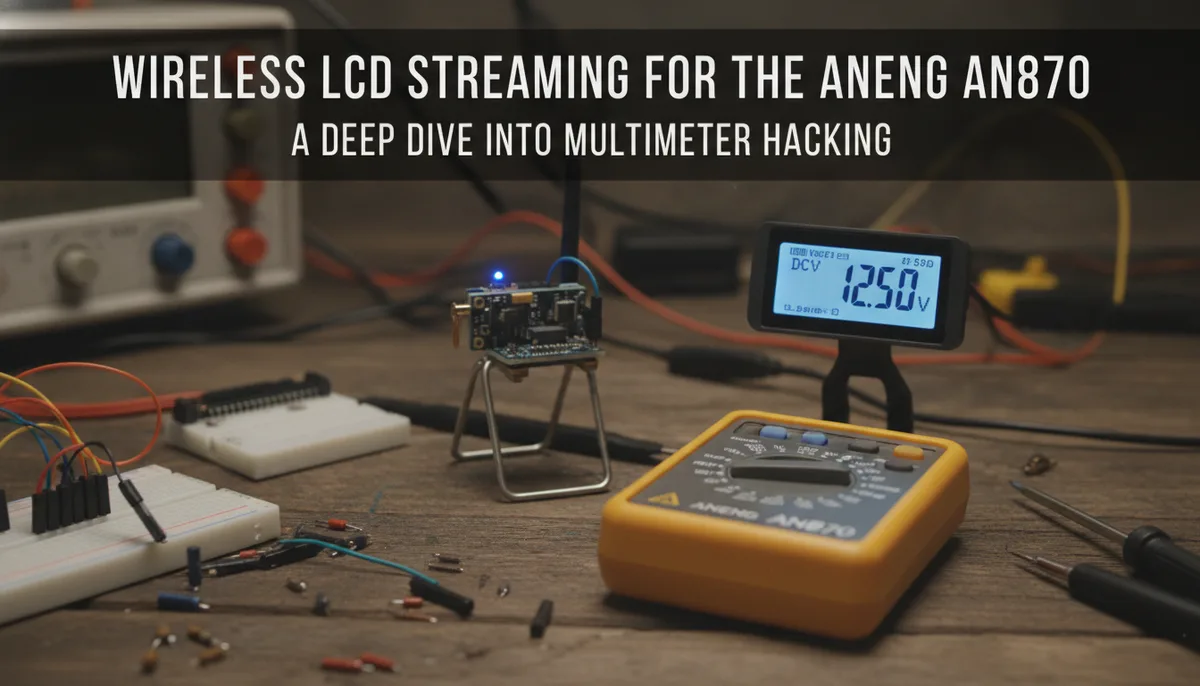
Wireless LCD Streaming for the ANENG AN870: A Deep Dive into Multimeter Hacking
The ANENG AN870 has long been a favorite in the maker community. It offers a high-count display, decent accuracy, and a price tag that makes it accessible for hobbyists and professionals alike. However, like many budget-oriented digital multimeters (DMMs), it suffers from one major limitation: it is a "siloed" device. It displays data on its own screen, but it offers no native way to export that data to a computer for logging, analysis, or video production.
For creators who use Open Broadcaster Software (OBS) to film electronics tutorials or repairs, this usually means pointing a second camera at the DMM screen—a solution that is often plagued by glare, poor contrast, and parallax errors. A recent project by [Bits und Bolts] has changed the game for AN870 owners by intercepting the raw LCD signals and transmitting them wirelessly to a PC.
The Challenge of "Dark" Data in Budget DMMs
In the world of high-end test equipment, protocols like SCPI (Standard Commands for Programmable Instruments) allow users to talk to their devices over USB, Ethernet, or GPIB. Budget meters, however, rarely include these interfaces to keep costs down. The data exists internally in the meter’s processor, but it never leaves the plastic shell.
To get the data out, you generally have two choices:
- The Protocol Route: Tapping into the internal serial lines if the chipset supports it (often hidden or disabled).
- The Display Route: Intercepting the signals sent to the LCD.
The project featured here takes the second route. By "scraping" the display data directly from the pins driving the glass, the mod creates a perfect digital replica of whatever the user sees on the meter, including units (V, mA, Ohm) and decimal points.
Decoding Multiplexed LCD Signals
Most modern multimeters use multiplexed LCDs to save on microcontroller pins. Instead of having one wire for every single segment on the screen, the display uses a grid of "Common" (COM) and "Segment" (SEG) lines. By varying the phase and voltage across these lines, the controller can turn individual segments on or off.
To replicate the display, [Bits und Bolts] had to map every single segment of the AN870's screen. This is a painstaking process of identifying which COM/SEG combination corresponds to which physical bar on the digits. Once mapped, an RP2040 Zero acts as the "brain" inside the meter. It monitors the state of these pins in real-time, reconstructs the digits, and prepares the data for transmission.
The Hardware Stack: RP2040, HC-12, and ESP32-C3
The modification is split into two distinct parts: the Sender (inside the DMM) and the Receiver (connected to the PC).
The Internal "Sender" Module
Inside the AN870, space is at a premium. The project utilizes a custom PCB designed to sit between the mainboard and the LCD. The hardware includes:
- RP2040 Zero: Chosen for its incredibly small footprint and high processing power, which is necessary to sample multiple analog-ish LCD lines simultaneously.
- HC-12 Wireless Serial Module: This 433 MHz transceiver is used to send the decoded data out of the meter. While WiFi is an option, 433 MHz often provides better penetration through the meter's shielding and lower power consumption.
- Boost Converter: The AN870 runs on two AA batteries (2.4V to 3V). Since the RP2040 and HC-12 require a stable 3.3V, a small boost module is integrated to step up the voltage.
The External "Receiver" Module
On the computer side, the signal needs to be converted back into something a modern OS can understand. The receiver consists of:
- Another HC-12 Module: To catch the 433 MHz signal.
- ESP32-C3: This module takes the serial data from the HC-12 and serves it over WiFi. This allows the multimeter data to be accessed via a web-based overlay or a dedicated stream that OBS can ingest as a "Browser Source."
Installation and Precision Soldering
This is not a mod for the faint of heart. It requires tapping into the fine-pitch traces or pins of the LCD header. To perform this kind of work, you need a high-quality soldering iron with excellent thermal control and a fine tip.
If you are looking to upgrade your bench for this kind of precision work, you might want to check out our Pinecil V2 Review: Is the Hype Actually Real? to see if a portable iron is right for you, or browse our Best Portable Soldering Irons of 2024: A Field Guide for more options.
The custom PCB mentioned in the GitHub project page is a critical component. It simplifies the wiring significantly by providing a structured way to tap into the LCD lines without creating a "bird's nest" of wires that could interfere with the meter's accuracy or physical assembly.
Why This Matters for the Bench
Having a wireless, digital feed of your multimeter is more than just a "cool factor" for streamers. It offers several practical advantages:
- Safety: You can monitor high-voltage or high-current measurements from across the room, keeping yourself away from potential failure points.
- Long-term Logging: By sending the data to a PC, you can easily log battery discharge curves or thermal drift over hours or days—something the stock AN870 cannot do.
- Accessibility: For users with visual impairments, the data can be fed into screen readers or displayed on much larger monitors.
If you're planning to perform this mod, ensure you have a solid foundation in electronics assembly. Our The Soldered Anywhere Master Buying Guide covers the essential gear you'll need to handle the boost converters and microcontroller integration required for this project.
Final Thoughts: A New Life for Budget Gear
The project by [Bits und Bolts] is a masterclass in "making the most of what you have." By adding less than $20 worth of silicon and a clever custom PCB, a $35 multimeter is transformed into a wireless-enabled powerhouse that rivals features found in meters costing ten times as much.
Whether you want a clean OBS overlay for your next YouTube video or you simply want to log data to a CSV file for your next engineering project, this wireless LCD streaming mod is a definitive upgrade for the ANENG AN870.