
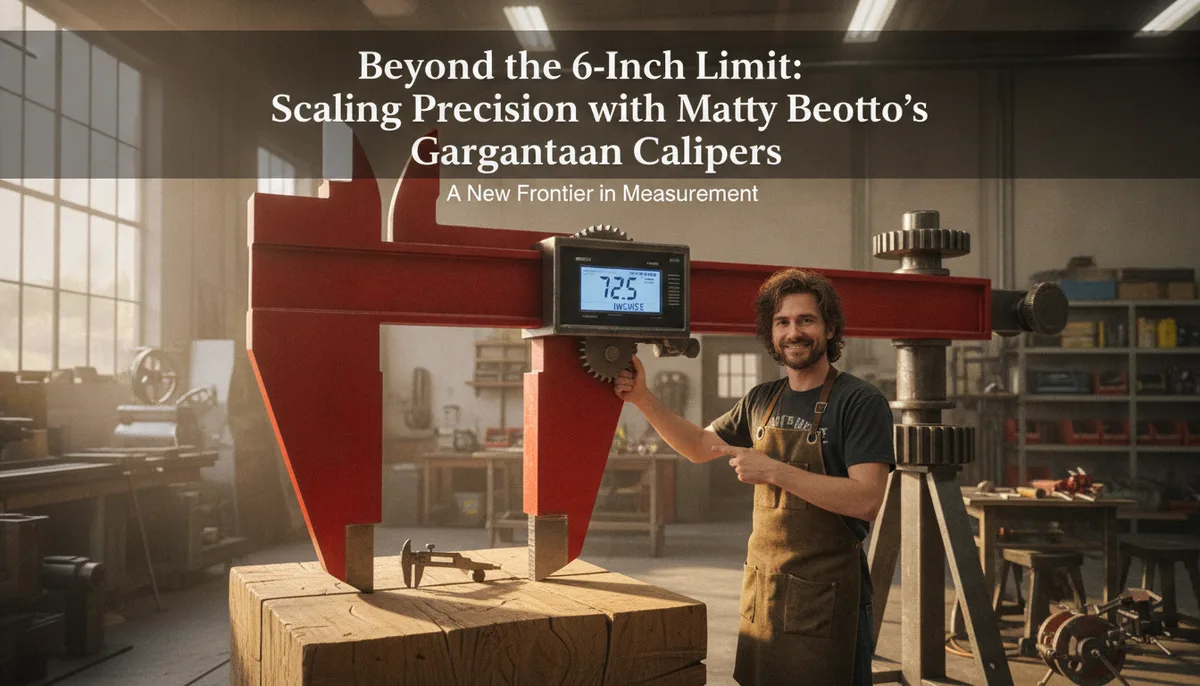
Beyond the 6-Inch Limit: Scaling Precision with Matty Benedetto’s Gargantuan Calipers
In the hierarchy of workshop tools, the digital caliper sits on a pedestal of necessity. Whether you are a seasoned machinist or a hobbyist just starting with a desktop 3D printer, the ability to measure a part within a thousandth of an inch is what separates a "project" from a "product."
However, the maker community often hits a literal wall: the 6-inch limit. The vast majority of affordable digital calipers—including those $20 models that professional engineers might scoff at but every hobbyist owns—top out at 150mm. When you need to measure the diameter of a car tire, the width of a custom PC chassis, or the dimensions of a large-scale furniture build, these standard tools fall short.
Matty Benedetto, the creative mind behind Unnecessary Inventions, recently challenged this limitation by building a set of gargantuan digital calipers. As reported by Cameron Coward at Hackster.io, these aren't just props; they are fully functional, massive measuring tools designed to handle the "almost anything" that standard tools cannot.
The Engineering of Scale: Why Bigger Isn't Always Simpler
On the surface, a caliper seems like a simple device: two jaws, a beam, and a sliding display. But as you scale a tool from 6 inches to several feet, the physics of measurement begins to work against you.
Material Rigidity and Flex
The primary enemy of large-scale measurement is "flex." In a standard 6-inch stainless steel caliper, the beam is rigid enough that the pressure of the jaws against an object doesn't cause the metal to bend. When Benedetto scaled his version up, he had to account for the structural integrity of the jaws. If the long arms of a massive caliper flex even a fraction of a degree, the measurement at the tips will be off by a significant margin.
The Linear Encoder Challenge
Standard digital calipers work using a capacitive linear encoder. Underneath the scale's sticker is a series of copper plates that interact with the sliding head to determine position. Scaling this requires either a continuous, high-precision PCB of immense length or a creative workaround. For many DIYers, hacking existing electronics is the path of least resistance. If you're interested in how tools can be modified beyond their factory settings, check out our guide on Wireless LCD Streaming for the ANENG AN870: A Deep Dive into Multimeter Hacking.
When to Buy vs. When to Build
For most makers, the choice between buying a specialized tool and building one comes down to the frequency of use.
If you occasionally need to measure objects up to 12 inches, it is often more cost-effective to purchase a dedicated long-reach tool rather than attempting a custom build that requires calibration. Large-scale calipers are available, though the price climbs rapidly as the beam lengthens.
Versatile Stainless Steel Digita...
However, Benedetto’s project highlights the "Maker’s Paradox": sometimes we build the tool because the tool we need doesn't exist at a reasonable price point—or simply because the act of building it teaches us more about the physics of our craft than buying it ever could.
The Utility of "Unnecessary" Inventions
While Matty Benedetto often brands his creations as "unnecessary," the gargantuan calipers touch on a very real need in the world of large-format fabrication. As 3D printers get larger and CNC routers become more accessible to home shops, the parts we produce are outgrowing our ability to verify them.
Consider the following scenarios where "standard" tools fail:
- Automotive Fabrication: Measuring the distance between mounting points on a chassis.
- Furniture Design: Ensuring that leg-tapers are symmetrical across a 48-inch tabletop.
- Large-Scale 3D Printing: Verifying the shrinkage rates of PETG or ABS on prints that span the entire diagonal of a 500mm build plate.
In these instances, a massive set of calipers provides a level of speed and intuitive feedback that a tape measure—which can easily hook incorrectly or sag—simply cannot match.
Precision in the Field and the Workshop
Building a massive tool is one thing; maintaining it is another. Large tools are prone to environmental factors. Thermal expansion can actually change the length of a plastic or metal beam enough to affect a measurement if you are working in a non-climate-controlled garage.
For those who take their tools into the field or work in less-than-ideal environments, durability is just as important as scale. Whether you are performing Emergency RC Repair: Soldering in the Pits or measuring a structural component on a job site, your tools need to be resilient. Benedetto’s build uses 3D-printed components, which allows for easy replacement of parts if they break, a philosophy that aligns with the modern "right to repair" movement.
Essential Gear for the Scaling Maker
If you find yourself frequently reaching the end of your 6-inch calipers, it might be time to upgrade your measurement suite. You don't necessarily need a 4-foot gargantuan set, but a well-rounded kit should include more than just the basics.
According to The Soldered Anywhere Master Buying Guide, a maker's measurement kit is never truly finished. To bridge the gap between "standard" and "gargantuan," consider adding these to your arsenal:
- 12-Inch Digital Calipers: The sweet spot for most large-scale 3D printing.
- Outside Micrometers: For when the calipers aren't precise enough for small diameters.
- A High-Quality Steel Rule: For quick checks where digital precision isn't required but rigidity is.
Mitutoyo 6 inch digital caliper
Conclusion: The Philosophy of Measurement
Matty Benedetto’s gargantuan calipers are a testament to the spirit of the maker community. They represent the refusal to be limited by "standard" specifications. While most of us will never need to measure a giant pizza or the width of a refrigerator with a pair of calipers, the project reminds us that our tools should serve our imagination, not the other way around.
Precision is relative. In a world where we often obsess over microns, sometimes the most important measurement is the one that reminds us of the sheer scale of what we can create when we stop following the rules of the 6-inch beam.
Whether you are hacking a multimeter, soldering in the pits, or printing a tool that is larger than your workbench, the goal remains the same: accuracy, utility, and the joy of making something that works.
Related product: Genuine Mitutoyo 500-196-30 Cali...
Related product: Versatile Stainless Steel Digita...
Related product: Genuine Mitutoyo 500-196-30 Cali...