
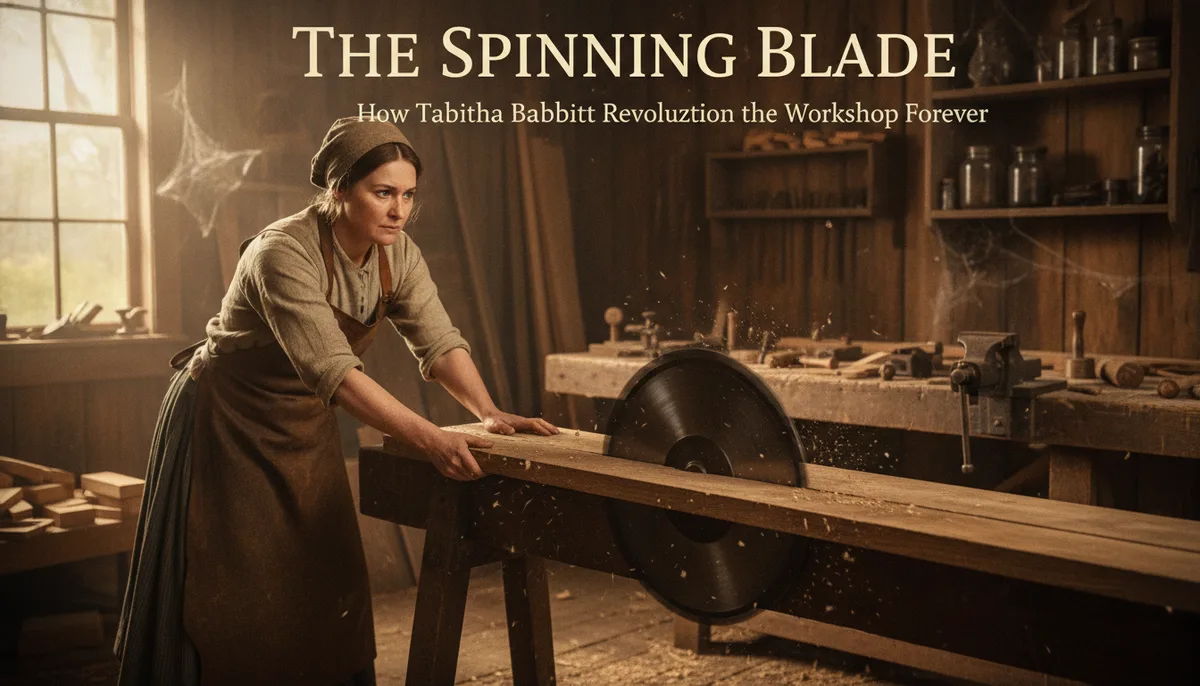
The Spinning Blade: How Tabitha Babbitt Revolutionized the Workshop Forever
The Origin of Efficiency: Observing the Pit Saw Struggle
In the early 1800s, the rhythm of a woodworking shop was dictated by the grueling pace of the pit saw. This massive, two-man tool required one person to stand in a pit below a log while another stood above it. Together, they would pull a long, straight blade back and forth. It was backbreaking work, but more importantly, it was fundamentally inefficient.
Tabitha Babbitt, a weaver and toolmaker living in the Shaker community of Harvard, Massachusetts, watched this process with a critical eye. She noticed a glaring flaw in the mechanical logic of the era: the saw only performed work during one half of its motion. The return stroke was "dead time"—energy spent with no result.
Babbitt’s insight was the spark that led to the invention of the circular saw. She realized that by mounting a notched blade onto a spinning wheel, the cutting edge would never have to stop or return. Every moment of rotation would be a moment of production. This leap in logic—moving from reciprocating motion to rotary motion—is a cornerstone of modern industrial design and remains a core principle in everything from the smallest rotary tool to the massive industrial saws used in modern timber mills.
From the Spinning Wheel to the Sawmill
Babbitt did not just theorize; she built. Drawing on her experience as a weaver, she utilized the mechanics of the spinning wheel to create her first prototype. She attached a circular tin blade to her foot-pedal-operated spinning wheel. When she tested it on a piece of wood, the continuous motion allowed for a smoother, faster, and more precise cut than anything the pit saw could achieve.
By 1813, her invention was being scaled up for use in the Shaker sawmill. This wasn't just a minor upgrade; it was a paradigm shift. The circular saw allowed for the mass production of lumber, which in turn fueled the expansion of infrastructure and housing.
For the modern maker, Babbitt’s process serves as a masterclass in "hacking" existing hardware. She looked at a spinning wheel—a tool meant for textiles—and saw a motor for a cutting system. This type of cross-disciplinary thinking is exactly what we celebrate today when we adapt budget electronics for high-end tasks. For example, just as Babbitt repurposed the spinning wheel, modern hackers are often Voiding the Warranty for Vision: Hacking Budget Celestron Microscopes for Ultra-Wide FOV to achieve results the original manufacturers never intended.
The Shaker Ethos: Innovation Without Ego
One of the most fascinating aspects of Tabitha Babbitt’s story is why you won’t find her name on an official U.S. patent for the circular saw. As a member of the Shakers, Babbitt lived by a strict code of communal ownership and simplicity. The Shakers believed that inventions were gifts to be shared for the common good, not tools for personal enrichment.
Because she never sought a patent, the credit for the circular saw was often contested in later years by commercial inventors. However, the Shaker records and local history firmly establish her as the pioneer of the circular blade in the United States.
This philosophy of "open-source" innovation predates the internet by centuries. Babbitt’s focus was on the utility of the tool and the betterment of the shop environment. When we look at our own benches today, we often ask: what is the favorite tool in the shop? Is it the one that cost the most, or the one that solved a persistent problem? Babbitt’s circular saw was the ultimate problem-solver.
If you are currently looking to upgrade your own shop with tools that prioritize this kind of efficiency and longevity, consulting The Soldered Anywhere Master Buying Guide can help you navigate the modern landscape of high-performance equipment.
high-performance 7-1/4 inch circular saw blade
The Technical Evolution of the Circular Blade
While Babbitt’s original saw was made of tin and powered by foot pedals or water wheels, the physics she established remain unchanged. The circular saw relies on centrifugal force and peripheral speed.
The Geometry of the Cut
A circular saw blade operates on the principle of "chip load." As the blade spins, each tooth removes a small "chip" of material. Because the blade is circular, the angle at which the tooth enters the wood changes throughout the cut. This requires specific tooth geometries—such as the Alternate Top Bevel (ATB) or Triple Chip Grind (TCG)—to ensure the wood doesn't splinter.
Material Science
Babbitt’s tin blade would quickly dull by modern standards. Today, we use high-carbon steel tipped with tungsten carbide. These materials allow the saw to maintain its edge even when cutting through dense hardwoods or composite materials.
BLACK+DECKER® 20V MAX Cordless...
Practical Guidance: Choosing and Maintaining Your Saws
Whether you are a woodworker or a hardware hacker building custom enclosures, the circular saw is likely a staple of your workflow. To honor Babbitt’s legacy of efficiency, your tools must be kept in peak condition.
- Blade Selection: Don't use a general-purpose blade for fine finishing. A high-tooth-count blade (60-80 teeth) is essential for clean cuts in plywood, while a lower-tooth-count ripping blade (24 teeth) is better for thick lumber.
- Calibration: A saw is only as good as its alignment. Use a digital gauge to ensure your blade is perfectly 90 degrees to the base.
- Field Maintenance: Sometimes, innovation happens outside the clean environment of a workshop. If you're working on a project in the field, having a portable kit is vital. Much like Emergency RC Repair: Soldering in the Pits requires a specific set of mobile skills, maintaining your saws on-site requires portable sharpening stones and consistent cleaning to prevent pitch buildup.
digital angle gauge for saw blades
Beyond the Saw: Babbitt’s Other Contributions
Tabitha Babbitt was a prolific inventor whose mind never seemed to stop analyzing mechanical processes. Beyond the circular saw, she is credited with:
- The Improved Spinning Wheel Head: She significantly increased the efficiency of yarn production, which was the lifeblood of the Shaker textile industry.
- Cut Nails: Before Babbitt, nails were forged individually by hand—a slow and expensive process. She developed a way to cut them from sheets of iron, drastically reducing the cost of construction.
Her life reminds us that STEM (Science, Technology, Engineering, and Math) has always been driven by those who are willing to look at a standard practice and ask, "Why do we do it this way?"
The Legacy of Women in Toolmaking
As we celebrate Women’s History Month, Tabitha Babbitt stands as a pillar of female ingenuity in a field—toolmaking—that was historically dominated by men. Her ability to observe a physical struggle and engineer a mechanical solution is the definition of the "maker spirit."
Babbitt didn't just invent a tool; she invented a new way of working. She proved that the most effective innovations often come from those who are closest to the work. By observing the strain of the pit saw, she was able to visualize a world where the machine did the heavy lifting, allowing the craftsman to focus on precision and artistry.
Today, every time we trigger a circular saw or hear the whine of a table saw, we are hearing the echo of Tabitha Babbitt’s spinning wheel. Her work ensures that our shops remain places of progress, efficiency, and endless possibility.
Related product: Digital Angle Gauge | Digital An...
Related product: 3-Piece 6-1/2-inch Circular Saw...
Related product: BLACK+DECKER® 20V MAX Cordless...
Related product: Digital Angle Gauge | Digital An...
Related product: 3-Piece 6-1/2-inch Circular Saw...