
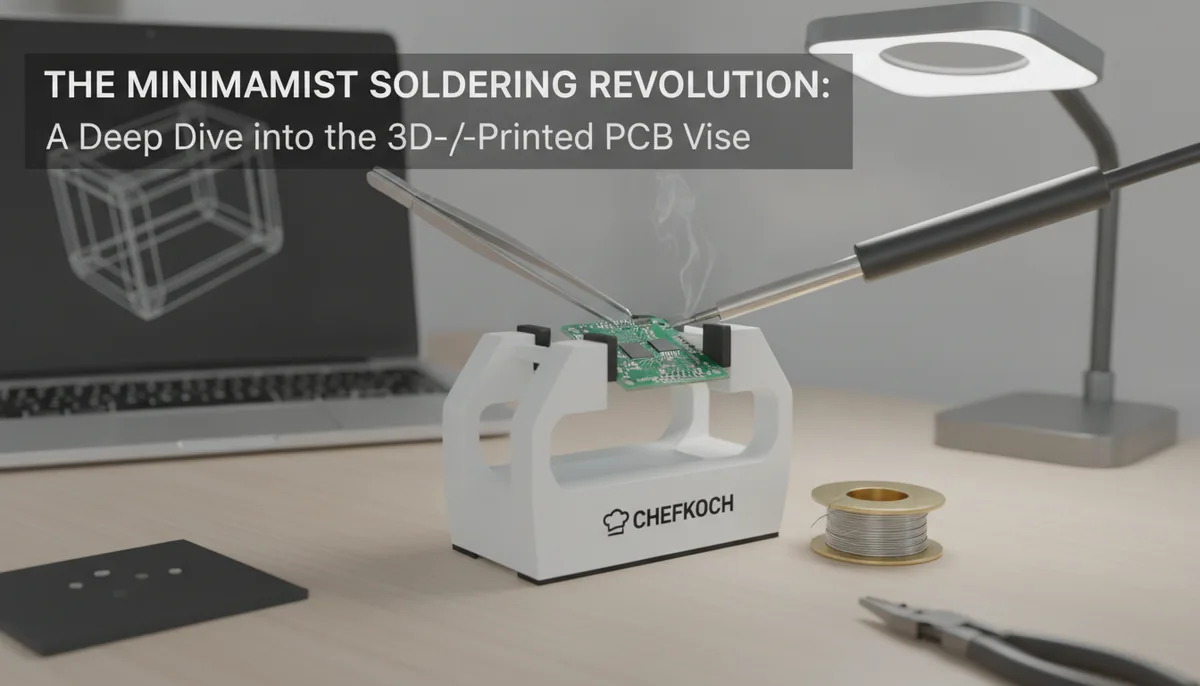
The Minimalist Soldering Revolution: A Deep Dive into the Chefkoch 3D-Printed PCB Vise
In the world of electronics manufacturing and repair, the "third hand" is an essential teammate. However, many commercial solutions are either overly bulky, taking up precious bench space, or too flimsy to hold a board steady during precision SMD work. Enter [Chefkoch]’s 3D-printed PCB vise, a masterclass in minimalist engineering that challenges the notion that a stable soldering station needs to be heavy or expensive.
By utilizing less than 70 grams of filament and zero external hardware, this design provides a high-utility tool that can be printed in a couple of hours. It is specifically designed for the modern maker who values portability and efficiency. Whether you are working on a dedicated electronics bench or performing Emergency RC Repair: Soldering in the Pits, this compact vise offers a professional-grade solution without the footprint of traditional cast-iron bases.
The Philosophy of Minimalist Tooling
The "scrap filament" project is a staple of the 3D printing community. We all have those spools with just a few meters left—not enough for a large helmet or a complex mechanical assembly, but too much to simply throw away. [Chefkoch]’s design hits the "sweet spot" of utility-to-material ratio.
At under 70g, it is lightweight enough to be tossed into a field kit but engineered with enough structural integrity to serve as a primary vise for small-to-medium PCB work. This efficiency doesn't just save plastic; it reflects a broader trend in the maker movement toward "functional printing," where the goal is to create tools that solve specific ergonomic problems with the least amount of waste possible.
Why 70 Grams Matters
For context, a standard 1kg spool of PLA can produce nearly 15 of these stations. This makes it an excellent project for STEM classrooms or makerspaces where budget and material conservation are priorities. Despite the low mass, the design does not sacrifice rigidity in the jaws, which is the most critical aspect of any PCB holder.
high-quality PLA+ filament for 3D printing
Engineering Brilliance: The Solder Spool Counterweight
The most innovative feature of this design is how it solves the "tipping" problem. Lightweight 3D-printed tools often slide around the desk or tip over when you apply the slight pressure of a soldering iron. Traditionally, makers solve this by adding lead weights, bolting the tool to a piece of wood, or using heavy steel bases.
[Chefkoch] takes a different approach: using the weight of the solder itself. By integrating the solder spool holder into the base of the vise, the design uses the mass of the solder (which you would have on your desk anyway) as a functional counterweight.
Center of Gravity and Stability
By placing the spool at the rear of the assembly, the center of gravity is shifted downward and backward. This offsets the forward-leaning weight of the PCB and the pressure of the soldering iron. It is a clever bit of "opportunistic engineering"—taking a necessary component of the soldering process and forcing it to do double duty as a structural stabilizer. This also ensures that your solder is always exactly where you need it, feeding directly toward the board.
Versatility in Design: Horizontal vs. Vertical Orientations
Not all soldering tasks are created equal. Sometimes you need to populate a board with resistors and capacitors (best done horizontally), and other times you need to solder pin headers or edge connectors (often easier with the board mounted vertically).
The [Chefkoch] vise is designed to be reconfigured. The jaws can be mounted in two distinct orientations:
- Horizontal Mode: Ideal for standard through-hole component placement and SMD soldering. This allows the user to rest their wrists on the table for maximum stability.
- Vertical Mode: Perfect for tinning wires, soldering connectors, or inspecting the board under a microscope.
This multi-functional capability is rare in such a small tool. While it may not replace the heavy-duty swivel vises found in The Soldered Anywhere Master Buying Guide, its versatility makes it a superior choice for mobile setups or secondary workstations.
The Hardware-Free Advantage
One of the biggest barriers to entry for many DIY tool projects is the "Bill of Materials" (BOM). Many 3D-printed designs require a specific list of M3 screws, heat-set inserts, or bearings. If you don't have those in your parts bin, a "free" project suddenly becomes a week-long wait for a shipping carrier.
This PCB vise is 100% 3D printed. Every pivot, jaw adjustment, and spool retainer is designed to work using printed tolerances.
Print Settings for Mechanical Strength
To ensure the hardware-free joints are durable, we recommend the following:
- Wall Count: Increase to 3 or 4 walls to give the threads and pivots more "meat."
- Infill: 25-30% Gyroid or Grid infill for compressive strength.
- Material Choice: While PLA is fine for most, PETG offers a bit more "flex" before breaking, which can be beneficial for the tension-based jaws of a vise.
Practical Applications and Limitations
While we are impressed by the design’s ingenuity, it is important to understand its intended use case. This is a compact tool designed for the "anywhere" workflow.
Best Suited For:
- Small Boards: Think Arduino Nanos, ESP32 modules, or custom sensor PCBs.
- Field Kits: Because it is entirely plastic and has no sharp metal edges, it is extremely "travel-friendly" for technicians who need to solder on the go.
- Secondary Stations: If you already have a large Panavise, this is a great secondary holder for "tinning" wires or holding a connector while your main board stays in the primary vise.
Limitations:
- Large PCBs: Boards larger than 100mm x 100mm may start to test the stability of the counterweight system, especially if the board is heavy with components.
- High-Heat Tasks: Since the jaws are plastic, you must be careful not to touch them with the tip of your iron. Unlike metal vises, a slip here can melt your tool.
Complementary Tools for the Mobile Lab
To truly maximize the "Soldered Anywhere" philosophy, this vise should be paired with other minimalist tools. The source mentions the "Solder Scroll," a pen-like DIY tool that makes handheld solder feeding more ergonomic. When you combine a 70g vise with a printed solder feeder and a portable USB-C powered iron, you have a professional-grade electronics lab that fits in a small padded pouch.
For those looking to expand their mobile capabilities even further, consider how this compact setup fits into a larger diagnostic workflow. For example, if you are performing precision repairs, you might pair this vise with a portable visual aid, as discussed in our guide on Voiding the Warranty for Vision: Hacking Budget Celestron Microscopes for Ultra-Wide FOV.
Final Thoughts: The Future of the DIY Workshop
The [Chefkoch] PCB vise is more than just a way to use up leftover filament; it is a testament to how smart design can replace heavy hardware. By utilizing the solder spool as a counterweight and creating a hardware-free assembly, this project empowers makers to build their own high-quality tools for pennies.
If you have a 3D printer and a messy soldering desk, this is a weekend project that offers immediate ROI. It simplifies your workspace, organizes your solder, and provides the "third hand" you need to take your projects to the next level.
Whether you are a seasoned engineer or a hobbyist just starting out, the lesson here is clear: you don't need a massive budget or a massive bench to produce high-quality electronics. You just need the right design.
Related product: Geeetech Color Gradient Filament...
Related product: Geeetech Color Gradient Filament...