
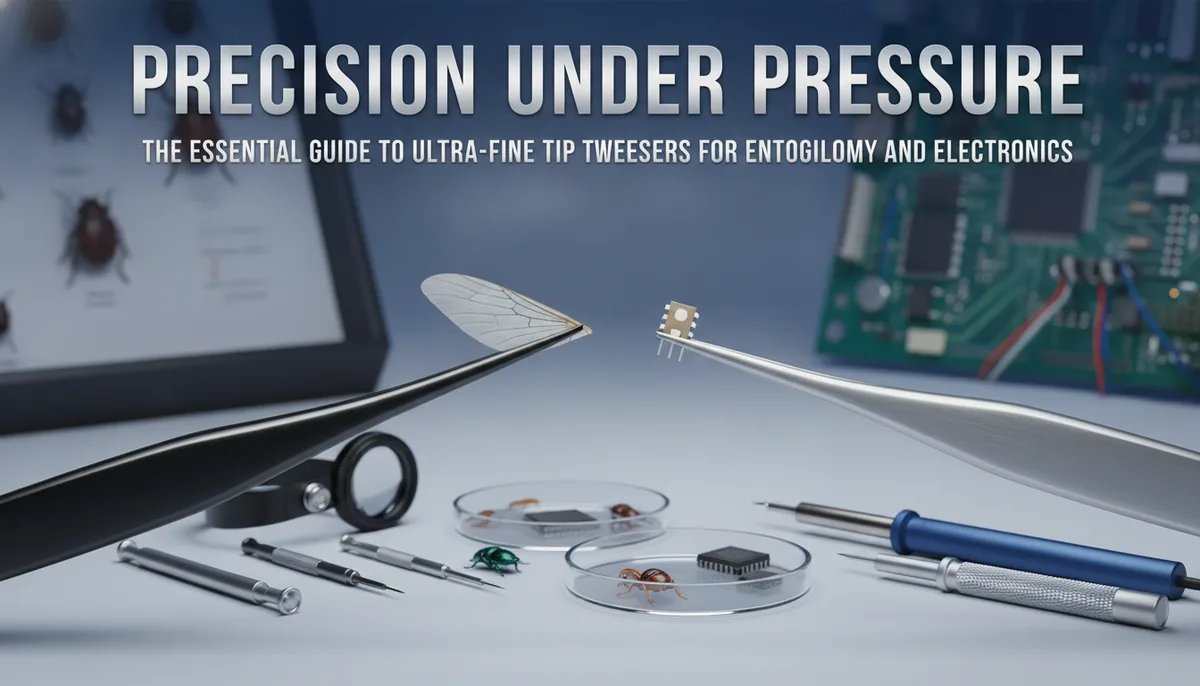
Precision Under Pressure: The Essential Guide to Ultra-Fine Tip Tweezers for Entomology and Electronics
In the world of precision work, the line between a biologist’s laboratory and an electrical engineer’s workbench is thinner than a strand of silk. Whether you are carefully mounting a rare Coleoptera specimen or attempting to hand-solder a 0201 resistor, the fundamental requirement is the same: the ability to manipulate objects that are nearly invisible to the naked eye.
This week, a social media inquiry regarding ultra-fine tip tweezers for entomology caught our attention. It served as a perfect reminder that the supply chains we often associate with "pure" engineering—like DigiKey—are actually treasure troves for scientists and hobbyists across all disciplines. When you need a tool that is inexpensive, durable, and capable of microscopic precision, the engineering catalog is often the best place to look.
The Anatomy of an Ultra-Fine Tweezer
Not all tweezers are created equal. When we talk about "ultra-fine" tips, we are referring to a specific geometry where the points taper down to a fraction of a millimeter. For entomologists, this allows for the manipulation of delicate insect legs or antennae without crushing the exoskeleton. For the hardware hacker, it means the difference between a successful repair and a "lost" component that flicked off into the carpet.
Tip Geometry and Alignment
The most critical factor in a high-quality tweezer is tip alignment. When you apply pressure, the tips must meet perfectly flush. If one side is slightly longer or if they meet at an angle, the tool will act more like a pair of scissors or a catapult than a gripping device. High-end brands found in engineering catalogs undergo rigorous quality control to ensure this "symmetry of closure."
The Role of Tension
Tension refers to how much force is required to squeeze the tweezers together. In entomology, "soft" tension is often preferred to prevent accidental damage to brittle specimens. In electronics, a slightly firmer tension provides better tactile feedback when moving components through viscous solder paste.
Why Stainless Steel is the Professional Standard
When searching for tweezers that balance cost and performance, stainless steel is the undisputed champion. However, "stainless" is a broad category. For both biological and electronic applications, you want an alloy that offers specific resistances.
- Corrosion Resistance: Biological specimens are often preserved in alcohols or other chemicals. Similarly, electronics work involves aggressive flux. A high-quality stainless steel (such as 304 or 316) ensures the tool won't rust or pit over time.
- Anti-Magnetic Properties: This is vital for electronics. If your tweezers become magnetized, a tiny capacitor will "jump" to the side of the tip rather than sitting flat on the PCB. For entomologists, anti-magnetic properties are less critical unless they are working with metallic mounting pins.
- Anti-Acid Properties: Many precision tweezers are labeled as "SA" (Stainless Anti-acid). This is a hallmark of a tool designed for long-term durability in harsh lab environments.
For a broader look at how these tools fit into a complete setup, check out The Soldered Anywhere Master Buying Guide.
Bridging the Gap: Entomology Meets SMD Soldering
It might seem strange to suggest that a bug collector and a drone repairman should shop at the same store, but the crossover is grounded in the physics of scale. Both fields have moved toward "miniaturization."
In entomology, the study of micro-hymenoptera (tiny wasps) requires tools that can handle structures smaller than a millimeter. In electronics, the shift from through-hole components to Surface Mount Devices (SMD) has made the standard "drugstore" tweezer obsolete.
Common Ground in Tools:
- Style 5 Tweezers: Known for having the sharpest, most tapered tips, these are the gold standard for both microscopic biological work and high-density PCB repair.
- Style 7 Tweezers: These feature a curved tip that allows the user to rest their hand on the bench while still maintaining a vertical approach to the subject. This is excellent for reducing hand fatigue during long sessions under a microscope.
If you are working at this level of precision, you likely need a way to see what you are doing. We’ve explored ways to enhance your vision in our guide on Voiding the Warranty for Vision: Hacking Budget Celestron Microscopes for Ultra-Wide FOV.
Sourcing Quality Without the "Scientific" Markup
One of the biggest hurdles for hobbyists and independent researchers is the "specialty tax." When a tool is sold specifically as a "Scientific Entomology Tool," the price often triples. However, by looking at industrial suppliers like DigiKey, you can find the exact same specifications—stainless steel, ultra-fine tip, anti-magnetic—at industrial prices.
Excelta 5-SA stainless steel tweezers
Brands like Aven, Excelta, and Wiha produce "industrial grade" tools that meet or exceed the requirements of a biological lab. When searching, look for "Precision Point" or "Microfine" descriptors.
Maintenance: Keeping Your Tips in Peak Condition
An ultra-fine tip is, by definition, fragile. A single drop onto a hard floor can turn a $30 pair of tweezers into a pair of useless hooks. To maintain your investment, follow these three rules:
1. Always Use the Protective Cap
Most precision tweezers ship with a small plastic tube or cap over the tips. Never throw this away. When the tool is not in your hand, the cap should be on. This prevents the tips from getting bent in a drawer or being blunted by contact with other tools.
2. Clean After Every Use
For electronics, use Isopropyl Alcohol (IPA) to remove flux residue. For entomology, ensure no organic matter or preservative fluids remain on the steel. Even the best stainless steel can suffer from "crevice corrosion" if contaminants are left to sit at the junction where the two halves of the tweezers are joined.
3. The "Whetstone" Resuscitation
If you do slightly bend a tip, all is not lost. You can often "re-point" tweezers using a fine-grit whetstone. By holding the tweezers closed and dragging the tips across the stone at a shallow angle, you can grind them back into a symmetrical point. This requires a steady hand and, ideally, magnification.
Aven 18476USA Technik Precision...
The Value of Specialized Tools in Modern Hacking
We often talk about "hacking" in terms of code or circuit boards, but the "Soldered Anywhere" philosophy is about the application of engineering precision to any problem. Whether you are fixing a broken trace on a smartphone or mounting a specimen for a museum collection, the tool is the interface between your intent and the physical world.
Using the right tweezer isn't just about making the job easier; it's about reducing the "chaos factor." When you have a tool you can trust not to drop, crush, or flick your subject, you can focus entirely on the delicate task at hand.
For those who find themselves repairing gear in less-than-ideal conditions, such as out in the field or at a competition, having a dedicated set of precision tools is non-negotiable. Learn more about field-ready setups in our article on Emergency RC Repair: Soldering in the Pits.
Final Thoughts: Choosing Your Pair
If you are just starting out, don't feel the need to buy a 20-piece kit. Start with two high-quality pairs:
- One Straight Style 5: For general-purpose precision.
- One Curved Style 7: For ergonomic work under magnification.
Look for the "SA" (Stainless Anti-magnetic) marking to ensure they will be useful across both hobbyist electronics and scientific endeavors. By sourcing these from engineering suppliers, you ensure you're getting a tool designed for 24/7 industrial use, which will likely last a lifetime in a home lab or field kit.
Precision is a discipline, and like any discipline, it is significantly easier to master when you aren't fighting your equipment. Whether you're an engineer or an entomologist, the "Great Search" for the perfect tool usually ends when you stop looking at the label and start looking at the specifications.
Related product: EXCELTA 5-SA Tweezers
Related product: Aven 18476USA Technik Precision...
Related product: EXCELTA 5-SA Tweezers