
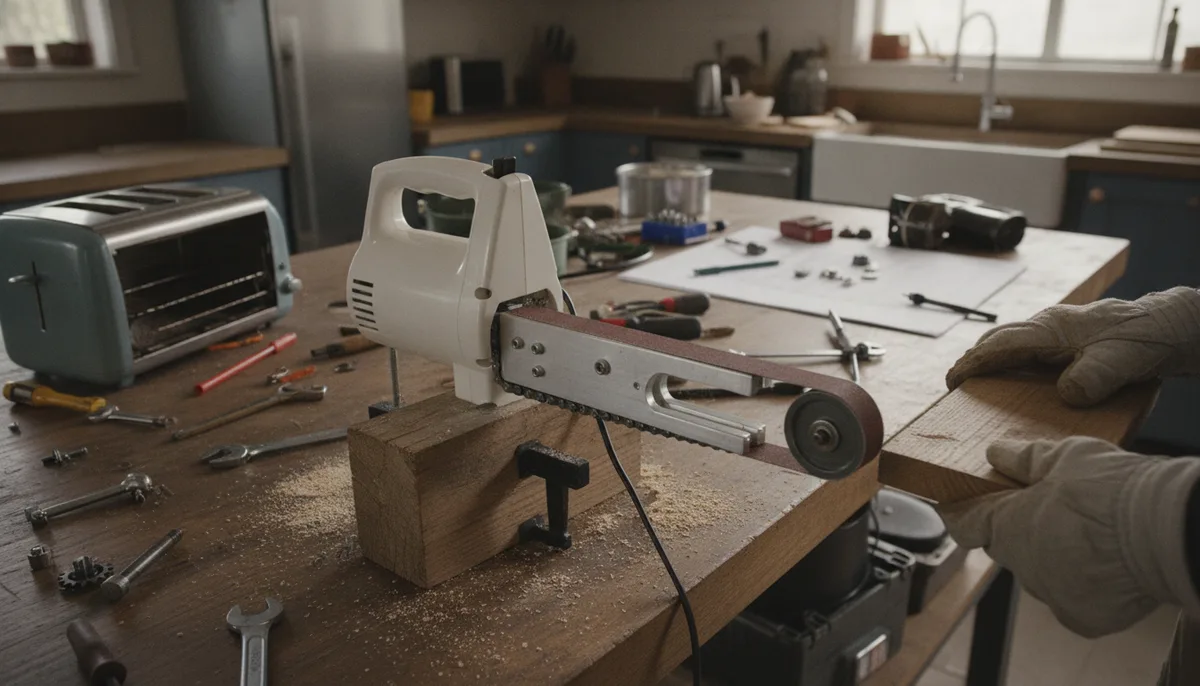
From Kitchen to Workshop: Engineering a DIY Belt File from an Upcycled Hand Mixer
The Philosophy of the Upcycled Workshop
In the world of hardware engineering and enthusiast making, there is a distinct satisfaction found in "voiding the warranty" of a common household appliance to create something entirely new. This practice, often referred to as upcycling or tool hacking, is more than just a cost-saving measure; it is an exercise in resourcefulness and mechanical problem-solving. A prime example of this is the recent project by maker [bluesyann], who successfully converted a standard kitchen hand mixer into a functional power belt file.
A belt file, often called a "finger sander," is an indispensable tool for metalworkers and woodworkers alike. It excels at reaching into tight crevices, deburring cut edges, and shaping complex geometries. However, professional-grade versions can be surprisingly expensive. By repurposing the motor and housing of a discarded mixer, [bluesyann] demonstrates how the fundamental components of an everyday appliance can be redirected toward a high-utility workshop application.
This approach aligns with the core ethos we often explore at Soldered Anywhere: the idea that engineering is not just about building from scratch, but about seeing the latent potential in existing systems. Whether you are voiding the warranty for vision or building custom shop tools, the goal is to bridge the gap between "scrap" and "solution."
Leveraging the Existing Enclosure
One of the most brilliant aspects of [bluesyann]’s build is the decision to keep the original mixer enclosure intact. In many DIY power tool projects, makers strip the motor out and attempt to build a new housing from scratch. While this allows for total design freedom, it introduces significant engineering hurdles: motor mounting, heat dissipation, and, perhaps most importantly, ergonomic handle design.
By retaining the mixer’s body, the project inherits a pre-engineered handle and a safe mounting point for the motor. Hand mixers are designed to be held for extended periods while vibrating, making them surprisingly ergonomic for a sanding tool. Furthermore, the internal wiring and switchgear are already managed. This "working around the bits one can’t change" philosophy is a hallmark of efficient engineering. It allows the maker to focus their energy on the unique requirements of the project—in this case, the belt tracking and tensioning system—rather than reinventing the wheel (or the handle).
Engineering the Belt Drive System
The transition from a rotating mixer shaft to a linear sanding belt requires a few critical components: a drive pulley, a tracking arm, and a tensioning mechanism.
The 3D Printed Drive Pulley
The drive pulley is the heart of the conversion. [bluesyann] utilized a 3D-printed pulley attached directly to the mixer’s motor shaft. When designing a drive pulley for a belt file, several factors must be considered:
- Bore Fit: The internal diameter must match the mixer shaft perfectly to prevent wobble, which would lead to belt slippage or catastrophic failure at high RPMs.
- Crowning: A slight "crown" or bulge in the center of the pulley is essential. Due to the physics of belt movement, a flat belt will naturally climb to the highest point of a rotating cylinder. A crowned pulley ensures the belt stays centered during use.
- Material Selection: While PLA or PETG can work for initial prototypes, the friction generated by a sanding belt can create significant heat. In a long-term tool, materials with higher glass transition temperatures or even a rubberized coating for extra grip are preferred.
The Tracking Arm and U-Channel
To extend the belt away from the motor, [bluesyann] used aluminum U-channel. This is a smart choice for a "junk bin" build. Aluminum is lightweight, rigid, and easy to drill. By nesting different sizes of U-channel, the maker created a telescopic arm that allows for the necessary reach and adjustment.
For those looking to stock their own workshop with the fundamentals for such builds, understanding the materials is key. Much like the engineering student’s toolkit, a collection of scrap extrusions and fasteners is the foundation of rapid prototyping.
Precision Tensioning and Tracking
A belt file is only as good as its tracking. If the belt slips off the side every time you apply pressure, the tool is useless. [bluesyann] solved this by integrating a threaded rod as a tension adjustment mechanism.
By turning the rod, the distance between the drive pulley and the idler bearing at the tip of the arm is increased. This takes up the slack in the sanding belt. Proper tension is a balancing act: too loose, and the belt slips; too tight, and you put excessive lateral load on the mixer’s motor bearings, which were originally designed for the relatively low resistance of cake batter, not the high-tension drag of a grit-coated belt.
When selecting belts for a project like this, it is important to match the belt width to your pulley design. Common sizes for small belt files include 1/2" or 3/4" widths.
If you are looking for high-quality replacements for a DIY or commercial sharpener, consider: 45x 3/4 x 12" Sanding Belts Repl... This set offers a wide range of grits, which is essential if you plan to use your DIY tool for everything from heavy material removal to fine knife sharpening. Alternatively, for narrower applications: Smiths Sanding Replacement Belt These are excellent for tighter spaces where the 1/2" profile is required.
The Limits of Upcycling: When to Go Pro
While [bluesyann]’s project is a masterclass in scrap-heap engineering, it is important to recognize the limitations of a mixer-based tool. Kitchen mixers are generally high-torque but lower-RPM compared to dedicated pneumatic or electric belt files. They are also designed for intermittent use. If you find yourself needing a tool for high-precision, continuous duty—such as professional electronics casing refinement or delicate jewelry work—a dedicated electric file might be a better fit.
For precision applications where a DIY mixer-tool might be too bulky, professional coreless motor files offer a different level of control. Medicool Pro Power 35k Coreless... While marketed for nail technicians, these high-torque, 35k RPM "E-files" are frequently used by hardware engineers and model makers for precision deburring and PCB trace modification. The coreless motor provides smooth rotation without the vibration often found in repurposed household motors.
Similarly, for those who don't have an old mixer but do have a standard angle grinder, there are commercial "finger sander" attachments that provide a similar result to [bluesyann]’s build but utilize the much higher power output of a 4.5-inch grinder.
Practical Guidance for Your Own Build
If you are inspired to build your own belt file from a mixer, keep these practical tips in mind:
- Motor Cooling: Most mixers have internal fans. Ensure your mounting hardware doesn't block the intake or exhaust vents. If the motor gets too hot, the plastic housing may soften, leading to misalignment.
- Bearing Quality: The idler pulley at the tip of the arm takes a lot of abuse. Use a high-quality sealed ball bearing rather than a simple bushing to minimize friction and heat.
- Belt Speed: If your mixer has multiple speeds, start at the lowest setting. The centrifugal force on a DIY 3D-printed pulley can be significant, and you want to ensure everything is balanced before cranking it up to "High."
- Surface Prep: For very small, intricate parts where even a belt file is too large, you might supplement your toolkit with micro-sanders.
50pcs Micro Detail Sander Paper... These are perfect for hand-finishing the areas that the belt file can't quite reach.
Conclusion: The Value of the "Broad Strokes" Design
[bluesyann]’s project reminds us that the best DIY builds aren't always about following a 50-step instruction manual; they are about understanding the "broad strokes" of a design. By identifying the core requirements—a motor, a handle, a pulley, and a tensioner—the maker was able to look at a piece of kitchen "junk" and see a valuable workshop asset.
In the world of hardware hacking, whether you are streaming data from a multimeter or building a power tool from a mixer, the true skill lies in the ability to adapt. The next time you see an appliance headed for the landfill, take a moment to look past its intended purpose. You might just find the heart of your next favorite tool.