
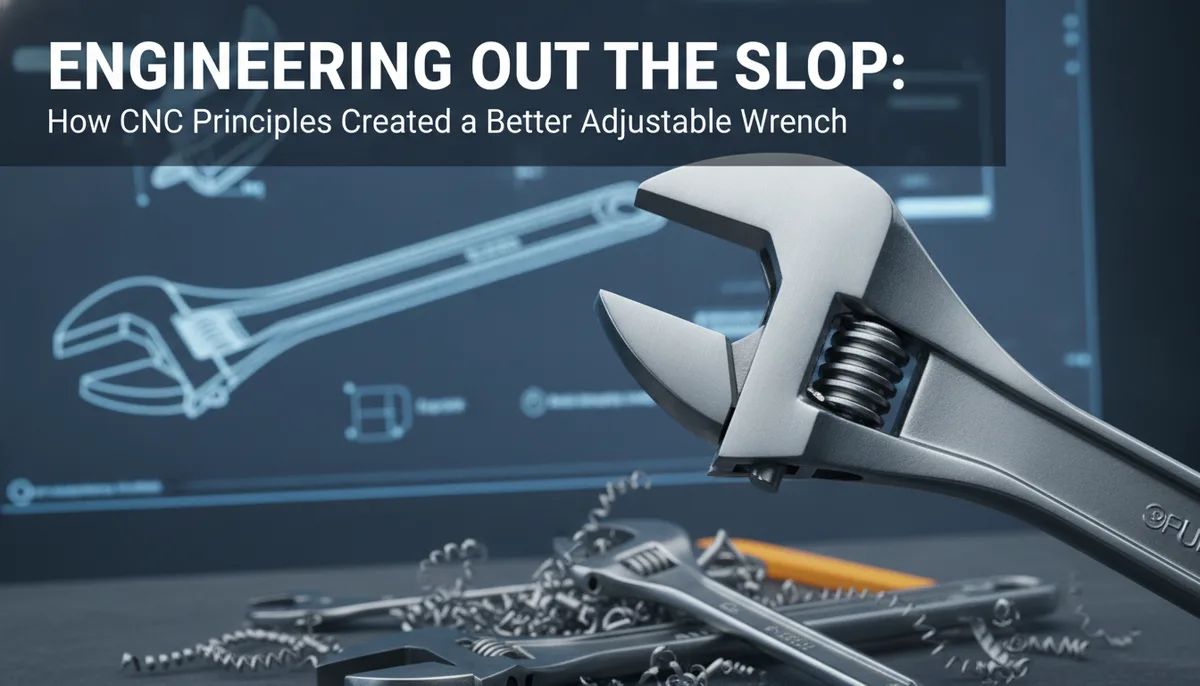
Engineering Out the Slop: How CNC Principles Created a Better Adjustable Wrench
The adjustable wrench is perhaps the most polarizing tool in the modern chest. To some, it is the "Crescent wrench," a versatile lifesaver that replaces a whole rack of fixed spanners. To others, it is the "nut-rounder," a clumsy instrument of destruction that seems specifically designed to strip the hex heads off of expensive fasteners.
The frustration is real. We have all been there: you tighten the thumb-screw as hard as you can, apply a bit of torque, and feel that sickening pop as the jaw shifts just a fraction of a millimeter. That tiny movement—the "slop"—is the difference between a successful repair and a nightmare involving extractors and drill bits.
Recently, a maker known as [Someone Should Make That] decided that griping about the tool wasn't enough. Drawing inspiration from the high-precision world of CNC machining, he set out to engineer a solution to the adjustable wrench’s oldest flaw. By applying the concept of anti-backlash threading to a hand tool, he created a version that stays tight, stays true, and refuses to round off bolts.
The Physics of the "Slop": Why Adjustable Wrenches Fail
To understand the solution, we first have to diagnose the mechanical failure of the traditional adjustable wrench. The core of the problem is backlash.
In any mechanical system where a screw (the worm gear) moves a linear component (the jaw), there must be a small amount of clearance between the threads. If the fit were perfectly tight, the friction would be so high that you wouldn't be able to turn the screw by hand. However, this necessary clearance creates "play."
When you apply force to a standard adjustable wrench, the resistance from the bolt pushes against the moveable jaw. This force takes up all the "slop" in the gear mechanism, causing the jaw to open slightly—often by just a few thousandths of an inch. That tiny gap allows the wrench to climb up over the corners of the bolt head. Once the force is concentrated on the corners rather than the flat faces, the metal deforms, and the bolt is rounded.
Borrowing from Precision Machinery: The Anti-Backlash Concept
If you have ever looked closely at a CNC mill or a high-end 3D printer, you’ll notice they don't suffer from this kind of play. If they did, the machines would be unable to return to the exact same spot twice, and your prints would look like a jittery mess.
Precision machines solve this using an anti-backlash nut. This mechanism typically involves two nut halves with a spring between them. The spring pushes the two halves apart, ensuring that the threads of the nut are always in contact with both sides of the lead screw’s threads simultaneously. There is no "dead air" for the screw to wiggle in.
[Someone Should Make That] applied this exact logic to the wrench. By integrating a spring-loading mechanism into the adjustment screw, the wrench maintains constant tension against the jaw. When you set the width, the spring takes up the slack immediately. When torque is applied, there is no "gap" for the jaw to shift into.
Anti Backlash Nut T8 for Acme Le...
Prototyping: From Plastic to Professional Grade
Modern tool development has been revolutionized by the ability to fail fast and iterate. Before cutting into expensive tool steel or aluminum, the designer utilized 3D printing to test the ergonomics and the mechanical viability of the spring-loaded screw.
Prototyping in plastic allows a designer to feel the "slop" (or lack thereof) in real-time. It’s a crucial step in the "this angers me, so I shall hack it" ethos of the maker community. Interestingly, even in the final CNC-machined version, certain components remained 3D printed to test longevity and ease of replacement.
For those looking to dive into their own tool-hacking projects, having a streamlined workflow for 3D navigation and CAD design is essential. Navigating complex assemblies like a multi-part wrench head requires precision. You can learn more about optimizing this process in our look at Rotatrix: Revolutionizing 3D Navigation for CAD and Design Workflows.
The Build: CNC Machining and Material Choice
The final iteration of the wrench was moved from the 3D printer to the CNC mill. Machining a tool from solid stock presents a different set of challenges than printing one. You have to consider tool paths, chip clearance, and the rigidity of the workpiece.
The designer opted for a design that mirrors the precision of the machines that created it. The use of a CNC-inspired screw isn't just an aesthetic choice; it’s a functional upgrade that requires tight tolerances that only a mill can provide.
For beginner CNC operators, this project serves as an excellent case study. It demonstrates how to translate a mechanical problem into a geometric solution. Some key takeaways for those starting in CNC include:
- Tolerance Stacking: Understanding how the tolerances of individual parts (the screw, the pin, the jaw) affect the final assembly.
- Material Hardness: While aluminum is easier to machine, a wrench needs to withstand significant PSI. Choosing the right alloy is the difference between a tool and a toy.
- Workholding: Machining the internal channels for the moveable jaw requires creative clamping to ensure everything remains square.
If you are looking to build out your workshop to handle projects of this caliber, check out The Soldered Anywhere Master Buying Guide for recommendations on the essential gear.
Is This the End of the Traditional Wrench?
While this CNC-machined masterpiece is a triumph of engineering, it does raise questions about the future of hand tools. Traditional adjustable wrenches are cheap and "good enough" for 90% of tasks. However, for the professional or the enthusiast who works on high-value hardware—where a single rounded bolt could mean hours of extra labor—the value of a "zero-slop" tool is immeasurable.
The project highlights a growing trend in the maker community: bespoke tooling. We are no longer limited to what is available at the local big-box hardware store. If a tool doesn't meet our standards, we have the CAD, 3D printing, and desktop CNC capabilities to redefine what that tool can be.
Conclusion: The Hacking Ethos
We support the "this angers me, so I shall hack it" mindset 100%. It is the core of innovation. Whether it's adding wireless streaming to a multimeter or reinventing the wrench, the goal is always the same: better performance through better engineering.
If you’re the type of person who can't stand a tool with a bit of wiggle, this project is a call to action. You don't have to settle for "slop." With a bit of inspiration from the machines in your shop, you can build a better mousetrap—or in this case, a better wrench.
For more deep dives into tool hacking and high-performance gear, explore our field guide on the Best Portable Soldering Irons of 2024.
Related product: Anti Backlash Nut T8 for Acme Le...