
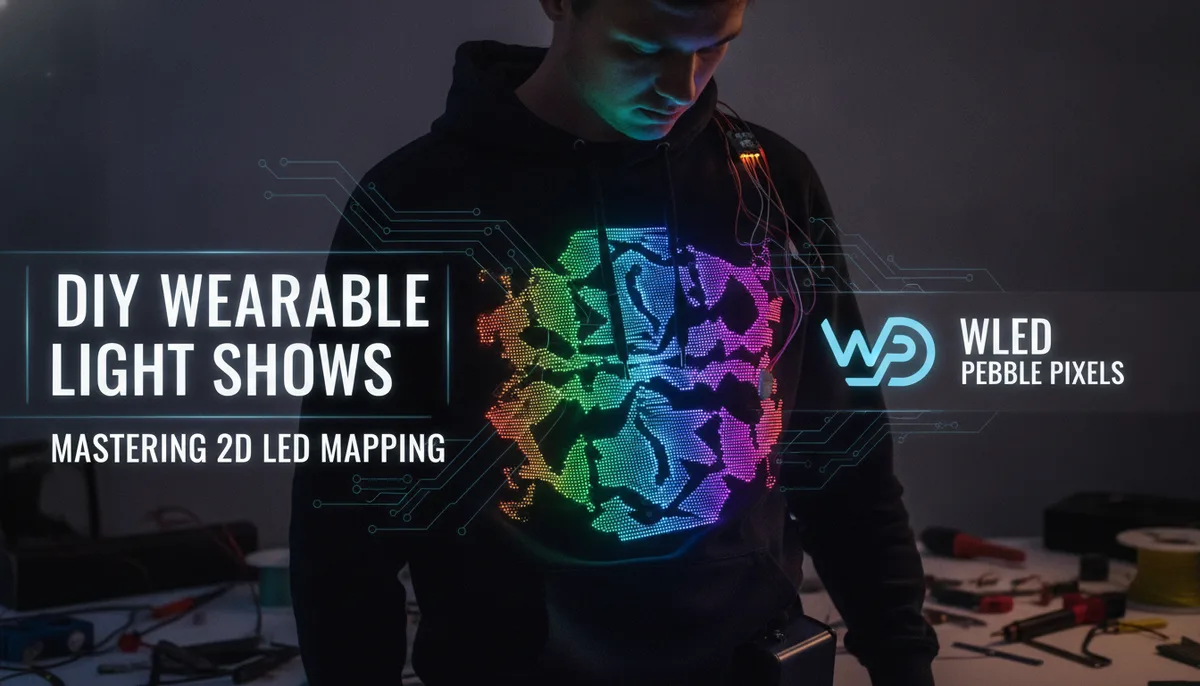
DIY Wearable Light Shows: Mastering 2D LED Mapping with WLED and Pebble Pixels
The Evolution of Wearable Illumination
For years, adding lights to a costume meant hot-gluing a string of battery-operated fairy lights or sewing in rigid strips of NeoPixels. While these methods provided a basic glow, they were often uncomfortable, fragile, and limited to simple blinking patterns. The landscape of wearable technology has shifted dramatically with the introduction of specialized hardware like the Sparkle Motion Mini and the sophisticated WLED firmware.
The goal is no longer just "making it light up." Today’s makers are looking for "Sparkle Motion"—a term that implies fluid, organic movement of light that responds to the wearer’s environment or follows complex geometric patterns. By utilizing 2D mapping, we can treat a skirt not as a single line of lights, but as a flexible video screen wrapped around the body.
The Hardware Stack: Sparkle Motion Mini and Pebble Pixels
The foundation of any high-end wearable project is the choice of microcontroller and LEDs. In the tutorial by Erin St Blaine, the focus is on the brand-new Adafruit Sparkle Motion Mini WLED Controller. This board is a game-changer for several reasons:
- Form Factor: It is incredibly small, designed specifically to be tucked into a pocket or sewn into a waistband without creating a bulky silhouette.
- ESP32 Power: Built on the ESP32 platform, it has the processing power to handle hundreds of LEDs and complex 2D math, while also providing built-in Wi-Fi for smartphone control.
- WLED Integration: It comes pre-loaded or optimized for WLED, the gold standard of open-source LED control software.
Complementing the controller are the LEDs themselves. Traditional 5050 SMD LEDs on a strip are prone to snapping when bent repeatedly. Adafruit Pebble Pixels solve this. These are tiny, individual addressable LEDs encased in a diffuse resin "pebble." They are connected by thin, flexible wires, making them ideal for sewing into fabric. They offer 360-degree light dispersion, which eliminates the "hot spots" often seen in cheaper LED projects.
Understanding the Magic of 2D Mapping
The most significant leap in this project is the transition from 1D to 2D mapping. In a standard setup, if you have 100 LEDs, the controller sees them as a line from 1 to 100. If you want a "downward" motion, you have to manually calculate which LED numbers are above others.
With WLED’s 2D mapping feature, you define a grid. Even if your LEDs are sewn in a chaotic or spiraling pattern on a petticoat, you can tell the software the approximate (X, Y) coordinate of each pixel.
Why Mapping Changes Everything
When the software understands the geometry of the garment, you can apply "2D Effects." Instead of a simple color chase, you can have:
- Fire Effects: Flames that realistically lick upward from the hem of the skirt.
- Matrix Rain: Green "code" falling vertically, regardless of how the wires are routed.
- Plasma Waves: Swirling colors that look like liquid moving across the fabric.
To get started with these advanced builds, having the right tools is essential. If you are looking to build out your mobile workstation for these types of projects, check out The Soldered Anywhere Master Buying Guide for recommendations on portable irons and precision tweezers that make working with Pebble Pixels much easier.
Construction Techniques: Building the Light-Up Slip
One of the smartest design choices in the Sparkle Motion project is building the tech into a slip or petticoat rather than the dress itself. This "modular tech" approach offers three distinct advantages:
- Versatility: You can wear the glowing slip under a wedding dress, a ballgown, or even a sheer skirt.
- Protection: The expensive electronics are shielded by the outer layers of the costume.
- Maintenance: It is much easier to repair a standalone slip than to tear apart a complex gown.
Sewing and Strain Relief
When attaching Pebble Pixels, avoid using glue. Glue can become brittle and crack, or it can damage the delicate wires. Instead, use a wide zig-zag stitch or hand-tack the wires to the fabric.
Crucially, you must implement strain relief where the wires meet the Sparkle Motion Mini microcontroller. Wearable tech is subject to constant movement, sitting, and dancing. Using a small 3D-printed enclosure or a reinforced fabric pocket for the controller prevents the wires from snapping at the solder joints.
If you find yourself at a convention or an event and a wire snaps, don't panic. Learning how to perform Emergency RC Repair: Soldering in the Pits provides excellent transferable skills for fixing wearable electronics under pressure.
Power Management for Long Events
A common pitfall for LED costumes is power. A high-density LED skirt can pull several amps of current at full brightness. To ensure your "Sparkle Motion" lasts through an entire gala or masquerade, consider these power strategies:
- USB Power Banks: Use a high-quality INIU Portable Charger 22.5W 1000... with at least a 2.1A output. The Sparkle Motion Mini is designed to take 5V power directly via USB or headers.
- Brightness Limiting: WLED has a built-in "Automatic Brightness Limiter." You can set the maximum milliamps your battery can handle, and the software will intelligently dim the LEDs to prevent the battery from overheating or shutting down.
- Color Choice: Pure white light uses three times more power than red, green, or blue alone. Using patterns with lots of "black space" (LEDs turned off) can triple your battery life.
Software Setup: Configuring WLED
Once the hardware is assembled, the configuration happens in the WLED interface. After connecting the Sparkle Motion Mini to your local Wi-Fi (or using its own Access Point mode), you navigate to the "2D Configuration" tab.
Here, you will define the dimensions of your "matrix." For a skirt, you might treat it as a cylinder. You’ll input the number of LEDs per row and how many rows you have. If your layout is irregular, WLED allows for a "Ledmap.json" file where you can specify the exact index of every pixel in your 2D space. This level of customization is what separates a DIY project from a professional-grade wearable.
Conclusion: The Future of Smart Textiles
The Sparkle Motion Skirt is more than just a costume; it is a proof of concept for the future of smart textiles. By combining the accessibility of WLED with the specialized form factor of the Sparkle Motion Mini and Pebble Pixels, the barrier to entry for high-end wearable tech has never been lower.
Whether you are building a ballgown for a wedding or a high-concept cosplay for a convention, the principles of 2D mapping and modular hardware will ensure your project is durable, beautiful, and truly "sparkling." As you embark on this build, remember that the most important tool isn't the soldering iron or the code—it's the creative vision of how light and fabric can move together.
Related product: INIU Portable Charger 22.5W 1000...