
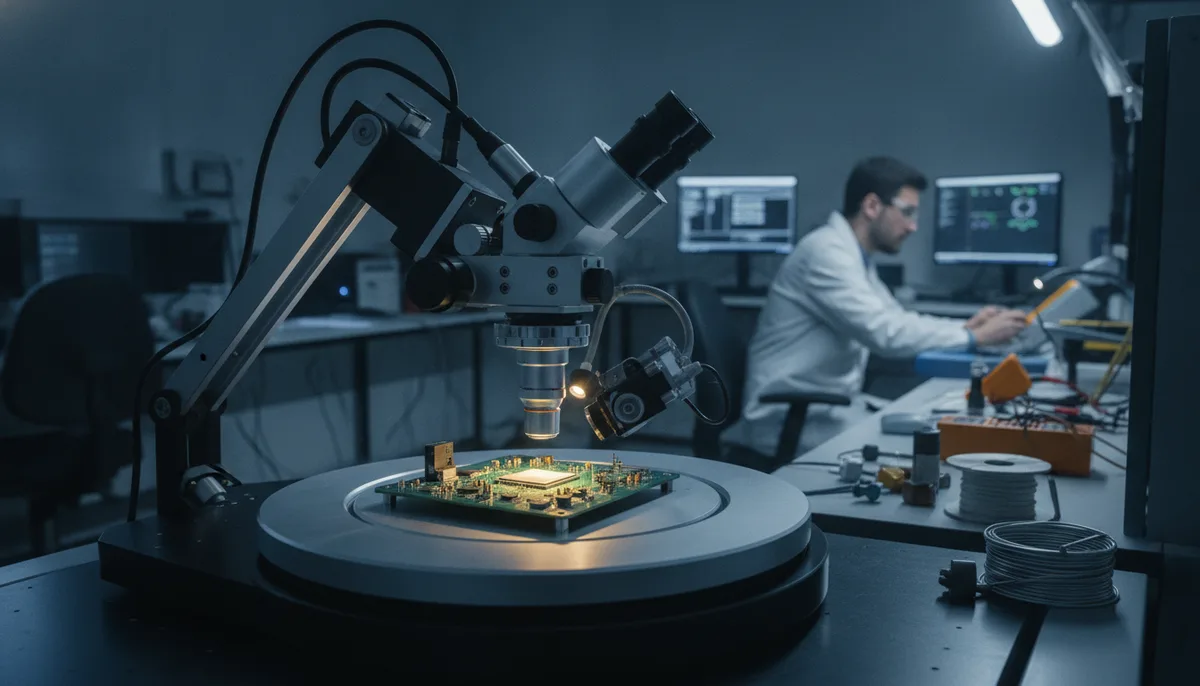
Beyond the Top-Down: Building a Rotating Side-Angle Microscope for Precision Electronics
As electronic components continue their relentless march toward miniaturization, the humble magnifying glass has long been relegated to the junk drawer. In the modern lab, a digital microscope is no longer a luxury; it is a fundamental requirement for anyone working with 0202 passives, fine-pitch QFP chips, or Ball Grid Array (BGA) components. However, even the most expensive digital microscopes often suffer from a perspective limitation: the "bird's-eye" view.
When you are inspecting a solder joint, a top-down view only tells half the story. You can see if the solder is present, but you cannot easily verify the quality of the wetting or the shape of the fillet. To solve this, maker [Corebb] engineered a custom solution: a rotating, side-angle microscope adapter that provides a true 3D perspective of the workpiece. This project represents a significant leap forward for home-lab inspection capabilities, bridging the gap between hobbyist gear and industrial inspection stations.
The Evolution of the Electronics Workbench
The shift from through-hole technology to Surface Mount Technology (SMT) changed the requirements of the engineering toolkit. While a basic multimeter and a steady hand were once enough, today’s hardware engineers require advanced visualization. We have previously discussed the necessity of high-quality gear in The Engineering Student’s Toolkit: Essential Gear for the New Academic Year, but as projects grow in complexity, "standard" gear often requires custom modification.
A standard digital microscope setup usually consists of a C-mount lens and a CMOS sensor mounted vertically. While this is excellent for placing components, it fails during the quality assurance (QA) phase. Without the ability to see "under" or "around" a component, hidden bridges and cold solder joints remain undetected until the board fails during testing.
The Engineering Challenge: Seeing Around Corners
The core innovation in [Corebb]’s design is a snap-on adapter that redirects the optical path. To achieve a side-view without moving the entire microscope assembly—which would be cumbersome and require constant refocusing—the adapter uses a periscope-like arrangement of mirrors.
Redirecting the Optical Path
The adapter utilizes a pair of mirrors to capture light from the side of the object and direct it upward into the main microscope lens. This allows the microscope to remain stationary while the "eye" of the camera effectively sits at a low angle relative to the PCB.
However, adding mirrors increases the distance light must travel before reaching the sensor. In optics, this increased path length shifts the focal point. To compensate for this, [Corebb] integrated a concave lens into the adapter. This lens effectively "shortens" the perceived optical path, allowing the primary C-mount lens to achieve focus despite the extra distance introduced by the mirror assembly.
The Need for Rotation
Static side-views are useful, but they only show one face of a component. To truly inspect a four-sided chip or a circular array of joints, the view must rotate. By utilizing ball bearings, the entire adapter assembly can spin 360 degrees around the microscope’s objective lens. This allows the operator to orbit the subject, providing a comprehensive view of every solder fillet from every possible angle.
For those looking to start with a high-quality base for such modifications, a robust industrial camera is essential.
Digital Monocular Microscope Cam...
The Digital Monocular Microscope Camera mentioned above provides the HDMI output and high resolution necessary to make these fine details visible on a large monitor, which is a significant upgrade over small, integrated screens.
Materials Matter: From Plastic to Aluminum
One of the most valuable takeaways from [Corebb]’s build is the transition from 3D-printed components to machined aluminum. In the world of high-magnification optics, even microscopic vibrations are amplified into nauseating jitters on the screen.
Initially, the adapter was 3D printed. While this allowed for rapid prototyping, the inherent flexibility of plastic meant that any touch or slight movement caused the image to shake. Furthermore, 3D-printed walls must be relatively thick to maintain structural integrity. These thick walls created unwanted shadows, blocking the very light needed to see the component.
By switching to machined aluminum, the design achieved two goals:
- Extreme Rigidity: The jitter was eliminated, providing a rock-steady image even at 200x magnification.
- Reduced Shadowing: Aluminum’s strength allowed for much thinner support struts, which minimized the "light footprint" of the adapter and allowed more ambient and ring light to reach the subject.
The adapter attaches to the microscope using small magnets. This ensures that the optical path is consistently aligned every time the adapter is snapped on, a much more elegant solution than thumb screws or friction fits.
Defeating Glare with Cross-Polarization
Solder is essentially a liquid mirror once it cools. This reflectivity is the nemesis of digital microscopy, often resulting in "blown-out" white spots on the image where the light hits the solder at a direct angle. To combat this, [Corebb] employed a technique well-known in professional photography and industrial inspection: cross-polarization.
The setup involves two polarizing filters:
- Filter A: Mounted on the LED ring light.
- Filter B: Mounted on the microscope lens.
By rotating Filter B until it is exactly 90 degrees offset from Filter A, the direct reflections (glare) are filtered out. Only the light that has been diffused by the surface of the PCB or the texture of the components passes through. This results in an image where the solder looks matte and grey rather than a blinding white, making it significantly easier to spot cracks, pits, or improper wetting.
If you are working on a tighter budget but still want to experiment with these optical principles, you might consider hacking a more basic unit. We have explored similar territory in our guide on Voiding the Warranty for Vision: Hacking Budget Celestron Microscopes for Ultra-Wide FOV.
Implementing Side-Angle Inspection in Your Workflow
Why go through the trouble of building a rotating side-view adapter? The practical applications in a professional or high-end hobbyist lab are numerous.
BGA and QFN Inspection
Ball Grid Arrays (BGA) and Quad Flat No-leads (QFN) components have their connections underneath the package. A top-down microscope can only see the edges of the chip. With a side-angle view, you can peek into the "canyon" between the chip and the PCB to ensure that the solder balls have collapsed and bonded correctly.
Solder Fillet Verification
According to IPC standards, a good solder joint should have a concave fillet with a specific wetting angle. From the top, a "ball" of solder (a cold joint) and a perfectly wetted joint can look remarkably similar. From the side, the difference is immediately obvious.
Inspecting for "Tombstoning"
In SMT reflow, small passives like resistors and capacitors can sometimes stand up on one end—a phenomenon known as tombstoning. While obvious at 0805 scales, at 0201 scales, a slight lift can be hard to diagnose from above. A rotating side view allows you to sweep the board and catch these height-based defects instantly.
For those who prefer a ready-made solution for general inspection before diving into custom optical hacking, a versatile stereo microscope can provide a solid foundation.
Swift Stereo Microscope M27B-124...
The Swift Stereo Microscope offers a traditional binocular view which provides natural depth perception, though it lacks the specific side-angle redirection of [Corebb]’s custom build.
The Future of DIY Optical Tools
The project by [Corebb] highlights a growing trend in the maker community: the "prosumerization" of lab gear. By combining affordable USB camera sensors with custom-machined optics and clever physics tricks like cross-polarization, individuals can now build tools that rival the performance of five-figure industrial inspection systems.
Whether you are a professional hardware engineer or a dedicated hobbyist, the ability to see your work from a new perspective is invaluable. As we continue to push the boundaries of what can be built in a home lab—from Engineering the Impossible: Building a High-Performance Air-Powered Table Saw with LEGO to complex multi-layer PCB designs—our tools must evolve alongside our ambitions.
Building a rotating side-view adapter is more than just a weekend project; it is an investment in the reliability of every circuit you build from this point forward. By mastering the optical path, you ensure that no solder bridge or cold joint can hide from your sight.