
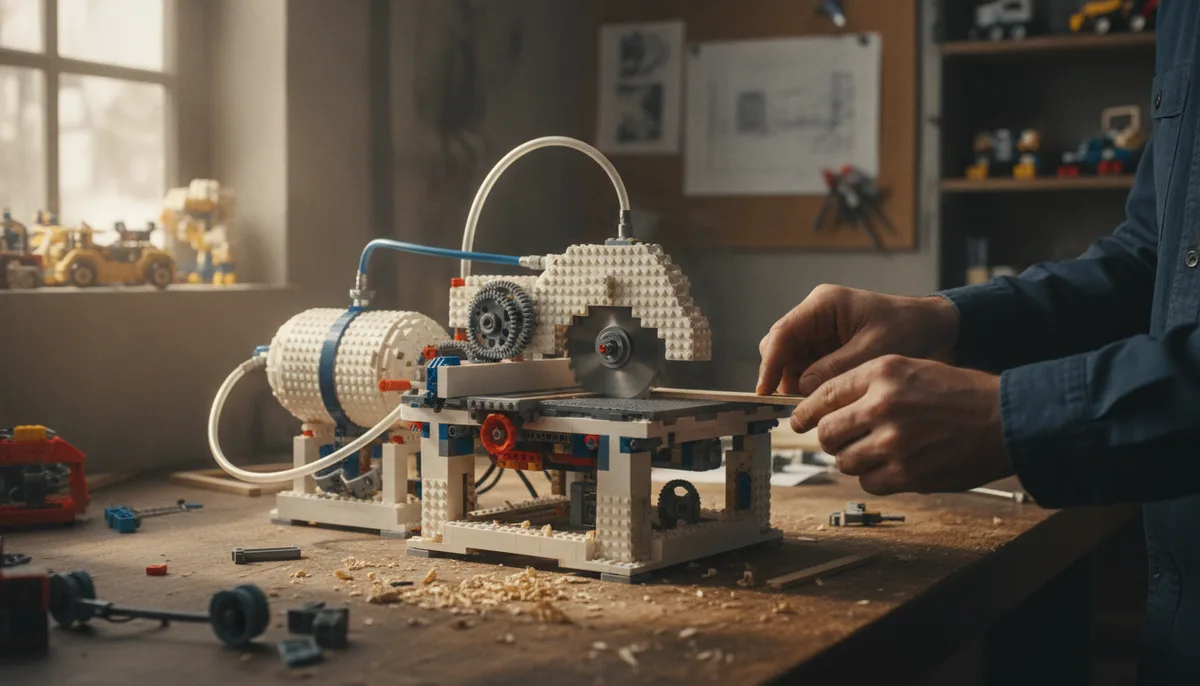
Engineering the Impossible: Building a High-Performance Air-Powered Table Saw with LEGO
The intersection of "childhood toy" and "industrial power tool" is a space few makers dare to inhabit. However, for the experimental engineer, the modular nature of LEGO Technic presents a tempting platform for rapid prototyping. We recently followed a project by a maker named Jamie, who pushed the boundaries of pneumatic engineering by constructing a functional table saw.
While the idea of a LEGO-based saw might sound like a novelty, the engineering behind it—specifically the transition from standard plastic gears to a custom 3D-printed air turbine—offers a masterclass in overcoming the mechanical limitations of hobbyist components. This wasn't just about snapping bricks together; it was about fluid dynamics, torque management, and the relentless pursuit of rotational speed.
The Physics of Air-Powered Rotational Motion
In the world of LEGO, motion is typically achieved through small 9V or Power Functions electric motors. While these are excellent for moving a plastic crane or a scale-model car, they lack the raw RPM and "stall-resistance" required to drive a metal saw blade through a piece of wood. Jamie’s solution was to bypass electricity entirely in favor of pneumatics.
Pneumatic systems work by converting the energy of compressed air into mechanical work. In most LEGO Technic sets, this is done via linear actuators—pistons that move back and forth to lift a bucket or open a door. To run a saw, however, you need continuous rotation. Jamie’s "star of the show" is a custom-designed air turbine.
Unlike a piston, which relies on the volume of air to displace a surface, a turbine relies on the velocity and pressure of the air hitting blades to create spin. The challenge here is efficiency. Standard LEGO pneumatic parts are designed for low-flow, high-pressure static holds. To get a saw blade spinning fast enough to actually cut wood without binding, Jamie had to iterate on the turbine's internal geometry.
Bridging the Gap: LEGO Meets 3D Printing
One of the most significant hurdles in this build was the limitation of the "out-of-the-box" LEGO ecosystem. While LEGO produces pneumatic cylinders, they do not produce high-speed air turbines. This is where 3D printing becomes the ultimate force multiplier for the modern maker.
Jamie went through several iterations of turbine blade design. The goal was to find a geometry that maximized the "impulse" of the air—the change in momentum as it strikes the blade. In a professional setting, this involves complex computational fluid dynamics (CFD). In the workshop, it involves printing a dozen variations and testing which one screams the loudest under 100 PSI.
The 3D-printed turbine acts as the heart of the machine, but it also highlights a critical lesson in hardware hacking: knowing when to stop using the original medium. Jamie discovered that while you can 3D print a saw blade, you probably shouldn't. The lack of a truly sharp, hardened edge on a plastic or resin-printed blade means it generates more friction and heat than actual cutting force. By integrating a real metal circular saw blade into a LEGO-supported arbor, the project moved from "cool toy" to "functional experimental tool."
For those looking to explore these mechanical limits, having the right diagnostic tools is essential. Much like how we analyzed The Compact Powerhouse: A Deep Dive into the Electrolama pt1 USB Multitool for Hardware Engineers, understanding the power draw—or in this case, the pressure drop—is vital to optimizing any custom build.
The Mechanical Build: From Bricks to Blades
The structural integrity of a table saw is paramount. A real table saw uses a heavy cast-iron table to dampen vibrations and provide a stable surface. LEGO, by contrast, is light and flexible. This creates a significant engineering problem: vibration.
When a metal blade spins at several thousand RPM, any slight imbalance is magnified. If the LEGO frame isn't rigid enough, the saw will "walk" across the workbench or, worse, the blade will oscillate and shatter the plastic housing. Jamie addressed this by building a robust frame using Technic beams, which offer much higher torsional rigidity than standard studded bricks.
The drivetrain also required careful consideration. Directly mounting a blade to a turbine can be risky if the turbine doesn't have the torque to overcome the initial "bite" into the wood. Using a geared-up or geared-down system allows the builder to trade speed for torque, depending on the thickness of the material being cut.
If you are beginning your journey into complex Technic assemblies, starting with a high-part-count kit can provide the structural elements needed for such a frame. LEGO Technic MBW M4 GT3 EVO Race... LEGO TECHNIC: Ferrari SF-24 F1 Car
Safety Protocols in Experimental Engineering
We must address the elephant in the room: a LEGO table saw is inherently dangerous. Standard LEGO is designed to be safe for children; a metal blade spinning at high velocity is not. Jamie’s build includes a "dead-man switch"—a pneumatic valve that must be held down manually for the air to flow. If the operator lets go, the air supply is cut instantly.
In any DIY project involving high-speed machinery, safety isn't just about a switch; it’s about the "fail-state." What happens if a LEGO gear shears off? In this build, the air-powered nature provides a slight safety advantage over a high-torque electric motor: if the blade binds in the wood, the air turbine will usually stall or the air will vent, whereas an electric motor might try to force its way through, potentially shattering the plastic frame.
However, the "careless primate fingers" warning from the source material remains the gold standard of advice. When you are voiding the intended use of a product—much like we've seen in Voiding the Warranty for Vision: Hacking Budget Celestron Microscopes for Ultra-Wide FOV—you become the lead safety engineer.
Powering the Build: The Pneumatic Infrastructure
To make this project work, you need a consistent and powerful source of compressed air. A hand pump won't cut it. Jamie utilized an air compressor to provide the sustained high-pressure flow required to keep the turbine at operating speed.
For makers looking to replicate or adapt this pneumatic logic, the infrastructure is just as important as the turbine itself. You need a way to regulate the air, store it in a reservoir to prevent "surges," and route it through hoses that won't pop under pressure.
If you’re looking to start experimenting with air-powered motion, these components are the essential building blocks: 4 Lego Pneumatic CYLINDERS Kit LEGO Pneumatic Parts
To provide the actual "juice" for the system, a portable but heavy-duty compressor is often the best choice for a home workshop setup: Heavy Duty Portable Air Compress...
Lessons for the Modern Maker
What can we take away from Jamie’s air-powered saw? Beyond the "cool factor," there are several practical engineering insights:
- Hybridization is Key: Don't be a purist. The most successful projects often combine different mediums—LEGO for the frame, 3D printing for the custom internals, and metal for the high-wear components.
- Air as a Variable Power Source: Pneumatics offer a unique way to handle stall conditions and variable loads that can be more forgiving than rigid electrical drives in a prototyping phase.
- The Importance of Feed Rate: Jamie experimented with an auto-feeding system. While it was "finicky," it highlights a truth in machining: the speed at which you push the material into the blade is just as important as the speed of the blade itself.
For more deep dives into the tools and components that make these builds possible, check out The Soldered Anywhere Master Buying Guide.
Ultimately, Jamie’s build is a testament to the "Soldered Anywhere" spirit—taking a set of constraints and pushing through them with creativity and a bit of compressed air. Whether you're building a saw or a sensor-laden robot, the goal is the same: to make something that the original manufacturers never imagined was possible. Just keep your fingers clear of the plastic-and-metal interface.