
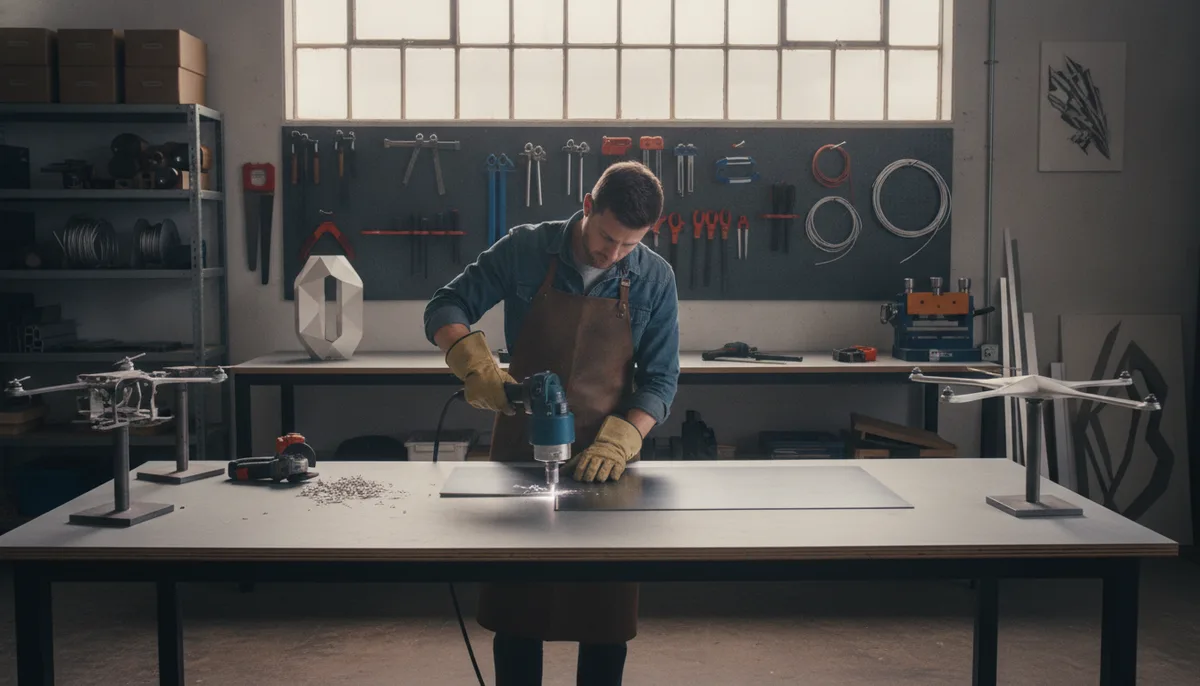
Metalworking for the Modern Maker: Mastering Aluminum Without a Welder
For many electronics enthusiasts and hardware engineers, the jump from "breadboard prototype" to "ruggedized field device" is often stalled by a single material: metal. We are comfortable with 3D-printed PLA, laser-cut acrylic, and even CNC-milled FR4, but the prospect of working with metal often brings to mind images of expensive TIG welders, industrial plasma cutters, and years of specialized training.
However, the barrier to entry is significantly lower than most realize. By focusing on aluminum—a material often called the "plastic of metals"—makers can achieve professional, structural results using tools already found in many home workshops. As seasoned maker Wesley Treat has demonstrated, mastering metalwork doesn't require a spark; it requires a shift in how we approach layout, cutting, and mechanical fastening.
The Case for Aluminum in Hardware Engineering
Aluminum is the ideal candidate for the "Soldered Anywhere" philosophy. It is lightweight, offers excellent thermal conductivity for heat sinking, and provides natural EMI shielding for sensitive circuits. Unlike steel, which requires heavy-duty equipment and rust prevention, aluminum is corrosion-resistant and incredibly forgiving to machine.
When selecting material for a project, you generally encounter two primary alloys: 6061 and 5052.
- 6061-T6: This is the "standard" structural aluminum. It is stiff and machines beautifully, making it perfect for enclosures, mounting brackets, and internal frames.
- 5052-H32: If your project involves intricate bending or folding, 5052 is the superior choice. It is more "gummy" and ductile, meaning it won't snap at the corner when you put it in a sheet metal brake.
For those just starting to build out their workspace for these projects, understanding the nuances of these materials is as critical as selecting the right components for a circuit. If you are currently refining your mobile lab, you might find our guide on The Engineering Student’s Toolkit: Essential Gear for the New Academic Year helpful for identifying overlapping tools that serve both electronics and light fabrication.
Precision Layout: The Foundation of Quality
In woodworking, a pencil line is often "good enough." In metalworking, precision is measured in thousandths of an inch. Because metal doesn't compress or "give" like wood or plastic, your layout must be exact.
Using Layout Fluid
Professional metalworkers use a blue dye (often called Dykem) to coat the surface of the metal. Once dry, you use a hardened steel scribe to scratch your dimensions into the dye. This creates a razor-thin, high-contrast line that is far more accurate than a graphite mark.
The Importance of the Center Punch
Before drilling any hole in aluminum, you must use a center punch. Because aluminum is slick, a drill bit will "walk" across the surface, ruining your alignment. A quick tap with a spring-loaded punch creates a small divot that captures the tip of the drill bit, ensuring your hole is exactly where you intended it to be.
Cutting Aluminum Without Industrial Machinery
One of the most surprising aspects of non-welding metalwork is that your woodworking tools are often more capable than you think. Aluminum is soft enough that carbide-tipped blades can slice through it with ease, provided you follow a few safety and maintenance rules.
The Miter Saw and Circular Saw
A standard miter saw equipped with a high-tooth-count, non-ferrous metal blade can produce factory-clean cuts on aluminum extrusions and bars. The key is lubrication. Using a stick of jeweler's wax or a quick spray of WD-40 on the blade prevents the aluminum from "galling"—a process where the heat of the cut causes the metal to melt and fuse to the teeth of the blade.
20" Non-Ferrous Metal Cutting Ci...
The Power of the Nibbler
For sheet metal work, especially when cutting out holes for LCD screens or connectors, a "nibbler" is an indispensable tool. It works by punching out tiny semi-circles of metal as it moves, allowing for complex curves without the distortion caused by tin snips. This is particularly useful when hacking existing hardware, such as the modifications discussed in our look at Voiding the Warranty for Vision: Hacking Budget Celestron Microscopes for Ultra-Wide FOV.
Fastening Strategies: Replacing the Weld
If you aren't welding, how do you hold the project together? Mechanical fastening is often superior to welding for maker projects because it allows for disassembly, repair, and the joining of dissimilar materials (like mounting a PCB stand-off directly to a chassis).
Structural Riveting
Pop rivets are the unsung heroes of non-welding metalwork. They are permanent, vibration-resistant, and incredibly easy to install. By using "blind" rivets, you can join two pieces of metal even if you only have access to one side of the assembly. For a professional look, countersunk rivets can be used to keep the surface of your enclosure flush.
Threaded Inserts and Tapping
For projects that require frequent access—such as a battery compartment or a sensor housing—tapping threads directly into the aluminum is a viable option. However, because aluminum is soft, threads can strip over time. In these cases, using "Rivnuts" (threaded inserts) provides the strength of a steel nut inside a thin aluminum wall.
This approach is ideal when building custom housings for sophisticated tools like the The Compact Powerhouse: A Deep Dive into the Electrolama pt1 USB Multitool for Hardware Engineers, where you need a durable enclosure that can still be opened for firmware updates or hardware tweaks.
Deburring and Finishing: The Professional Touch
The difference between a "DIY project" and a "professional product" is often found in the edges. Freshly cut aluminum is incredibly sharp and often features "burrs"—small shards of metal clinging to the cut line.
The Deburring Tool
A swivel-head deburring tool is a specialized blade that hooks onto the edge of a cut or the inside of a hole. With one smooth motion, it peels away the burr, leaving a clean, chamfered edge. This is not just for aesthetics; it prevents wires from being chafed and fingers from being cut.
Surface Finishes
Aluminum oxidizes quickly, forming a thin protective layer. While this prevents deep corrosion, it can look dull. To achieve a professional finish, you have several options:
- Brushed Finish: Use a medium-grit Scotch-Brite pad and rub in a single direction to create a "brushed" look.
- Sanding: Progressing from 220 to 600 grit sandpaper will produce a smooth, matte finish.
- Chemical Etching: A quick dip in a mild acid or specialized aluminum cleaner can prep the surface for professional-grade painting or clear coating.
Integrating Electronics and Metalwork
When your metalwork is finished, the integration phase begins. Working with aluminum offers unique advantages for the electronics hobbyist.
Thermal Management
If you are building a high-power LED driver or a motor controller, the entire chassis can act as a giant heatsink. By using thermal paste or thermally conductive pads between your components and the aluminum wall, you can significantly lower operating temperatures without the need for noisy fans.
Grounding and Shielding
Aluminum is an excellent conductor. When building sensitive RF projects or high-gain audio circuits, a metal enclosure acts as a Faraday cage. However, ensure that your "ground" is consistent. Because the naturally occurring aluminum oxide is an insulator, you may need to use star washers that "bite" through the oxide layer to ensure a solid electrical connection between panels.
Conclusion: Expanding Your Maker Horizon
Stepping away from the welder doesn't mean stepping away from professional metalwork. By leveraging the unique properties of aluminum and focusing on precision layout and mechanical fastening, you can build structures that are just as strong and often more versatile than welded steel.
Whether you are building a custom rack-mount enclosure for your lab or a ruggedized housing for a field-deployed sensor, these techniques allow you to bridge the gap between "prototype" and "product." The tools are accessible, the material is forgiving, and the results—as Wesley Treat has shown—can be truly exceptional.